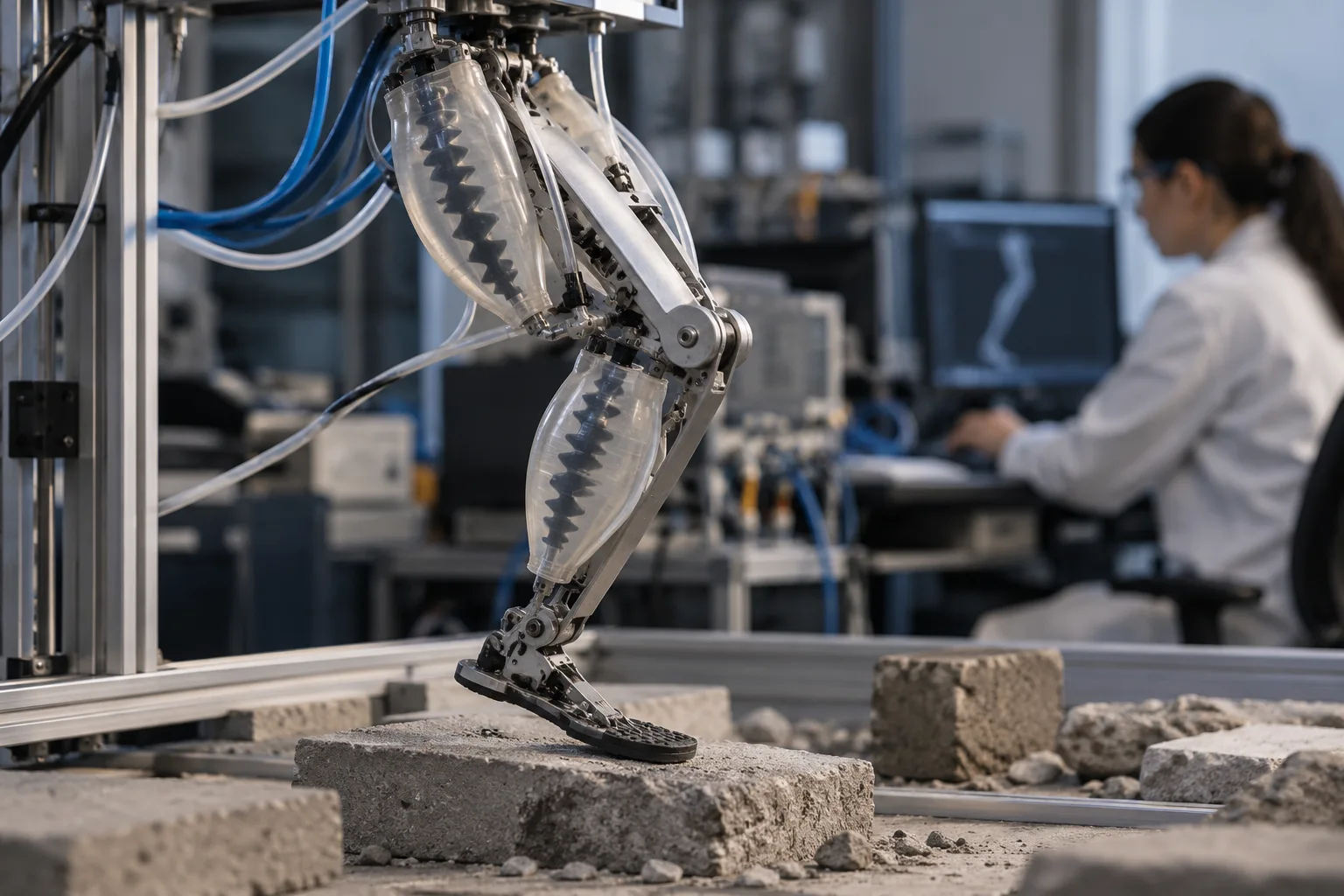
Robotic leg driven by electrohydraulic artificial muscles hops over varied terrain
What was demonstrated
ETH Zurich and Max Planck Institute for Intelligent Systems researchers built a musculoskeletal leg driven by antagonistic pairs of electrohydraulic (HASEL) artificial muscles. Mounted on a boom arm, it moved at gait frequencies above 5 Hz, jumped up to 40% of its own height and hopped over grass, sand, gravel, pebbles and large rocks using open-loop force control. It had a cost of transport of 0.73 and, while squatting, used about 1.2% of the energy of a conventional electromagnetic counterpart. It also detected obstacles through capacitive self-sensing.
Why it matters
Soft actuators that are energy efficient, compliant and self-sensing could reduce the need for heavy motors, gearboxes and separate sensors in legged robots.
Caveats
- The leg was constrained on a boom arm; it is not a free-standing walking robot.
- Electrohydraulic actuators need high drive voltages, which raises safety and power-electronics challenges.
- Long-term durability of the actuators under repeated loading was not established.
Technology profiles
Sources
- peer reviewed paper
Electrohydraulic musculoskeletal robotic leg for agile, adaptive, yet energy-efficient locomotion
Thomas J. K. Buchner, Toshihiko Fukushima, Amirhossein Kazemipour et al.. Nature Communications, 9 Sept 2024. DOI: 10.1038/s41467-024-51568-3.
Last reviewed 20 Oct 2026.