Artificial muscles (soft actuators)
Also known as Soft actuators, Muscle-like actuators, HASEL actuators, Twisted and coiled polymer actuators
Artificial muscles are soft materials and devices that contract, expand or twist when given heat, electricity or fluid pressure, producing movement in a way that resembles biological muscle. Laboratory systems span heated fibres, pneumatic structures and electrohydraulic or dielectric elastomer actuators. A 2026 dielectric elastomer demonstrated large strain over repeated cycles and recovery after damage, but its repairs required hours of heating and the wider field still faces power, control, safety and scale-up constraints.
In plain language
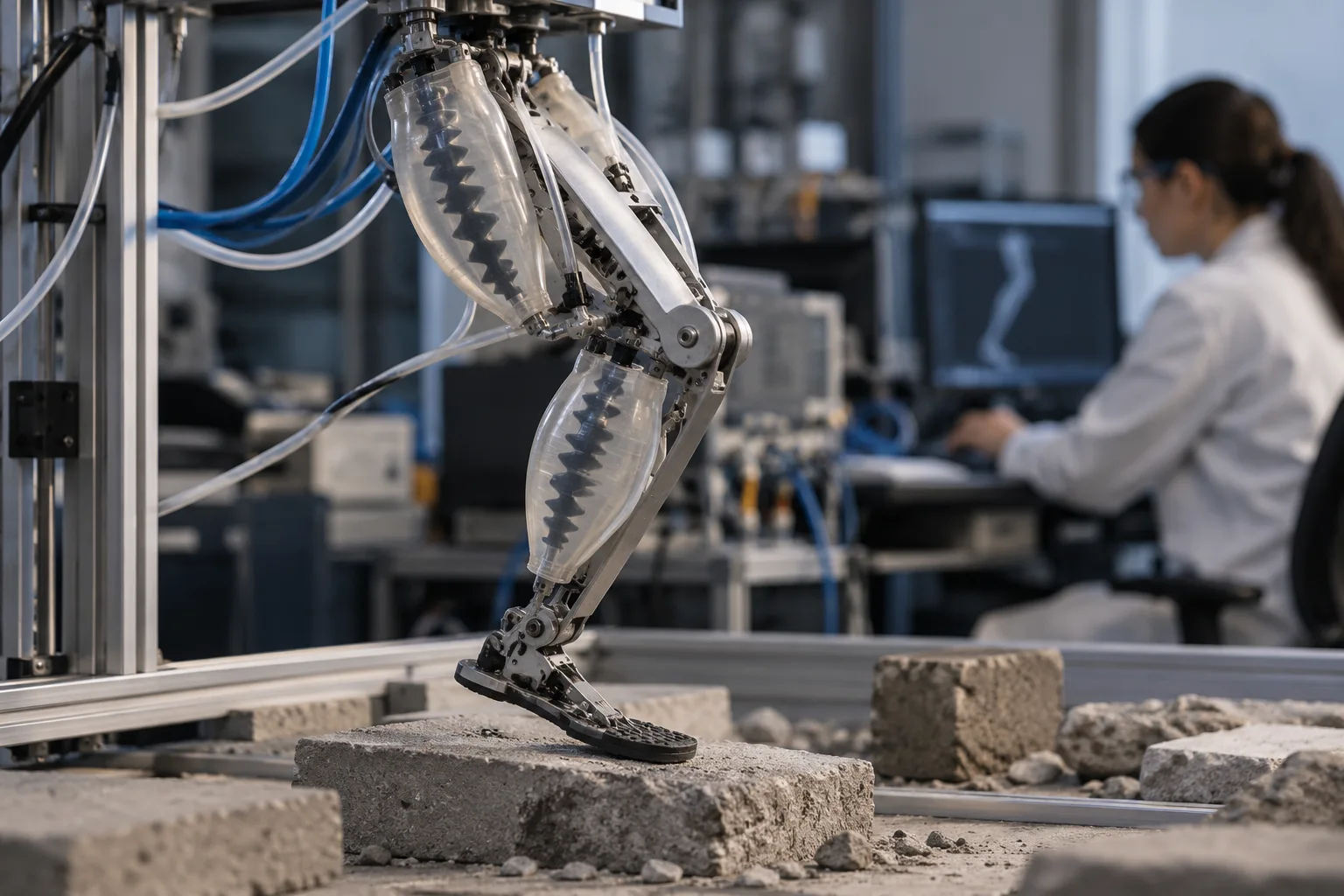
Most robots move using electric motors and gears, which are precise but heavy, rigid and noisy. Artificial muscles take a different approach: a piece of soft material changes shape when triggered, pulling or pushing like a real muscle. Examples include twisted nylon fishing line that contracts when heated, oil-filled plastic pouches that squeeze shut when a voltage is applied, and folded skeletons inside a sealed skin that collapse when air is sucked out.
In the lab, some of these devices can lift many times their own weight and move quickly. Researchers have used them to drive a robotic leg that hops over rough ground. They still face practical problems, such as needing high voltages, external pumps or heat, and they are mostly at the research and prototype stage.
A notable 2026 result came from a self-healing dielectric elastomer: a soft polymer film that changes shape when an electric field pulls on flexible electrodes. Its designers added zwitterionic groups to a two-scale polymer network. The material kept operating at 125% areal strain for 150,000 cycles under the reported test conditions, and researchers built a small actuated arm and gripper. This is a laboratory material and demonstrator. The test does not establish a service lifetime in a wearable or industrial robot, and repairing larger damage took roughly 30–60 hours at 60 °C.
Technical explanation
Several families of soft actuators compete. Thermally driven twisted and coiled polymer fibres, such as nylon fishing line or sewing thread, contract along their length when heated and return when cooled; heating can be resistive, optical or chemical. Fluid-driven actuators use a pressure difference across a skin: in vacuum-driven origami muscles, a compressible skeleton inside a sealed skin folds in a programmed way, giving contraction, bending or twisting. Electrostatic and electrohydraulic actuators, such as dielectric elastomers and HASEL (hydraulically amplified self-healing electrostatic) actuators, use electric fields to squeeze a soft dielectric; HASEL devices push a liquid dielectric within a flexible pouch, and the liquid lets them recover from electrical damage.
Reported performance varies by family and test conditions. A 2014 study, as summarised by the university, reported coiled polymer fibres contracting by about 50% of length and producing about 100 times the power of human muscle of equal length and weight. Vacuum-driven origami muscles reached over 90% contraction, about 600 kPa stress and peak power densities over 2 kW/kg in lab tests. Electrohydraulic (HASEL-type) muscles driven by amplifiers spanning -10 kV to 10 kV powered a tethered robotic leg that hopped at over 5 Hz and jumped to 40% of its leg height.
Trade-offs dominate engineering choices. Thermal fibres are made from cheap materials but rely on heating and cooling, so their speed and efficiency depend on how quickly heat can be added and removed. Fluidic muscles need pumps and valves, and one study found electrical-to-mechanical efficiency of only about 2 to 5% once miniature pumps were included. Electrohydraulic muscles can respond quickly and use little energy when holding a position, but need kilovolt supplies, insulation and safety electronics that are hard to make small enough for untethered robots.
A 2026 Nature Communications study addressed fatigue and dielectric breakdown in dielectric elastomer actuators (DEAs). The authors combined a bimodal polymer network with sulfobetaine methacrylate, a zwitterionic side group. They report a breakdown strength of about 95 MV/m, maximum electroactive area strain of 272%, and stable operation at 125% strain and 25 MV/m over 150,000 cycles. A separate dynamic test reported a specific energy of 152 J/kg and a specific power of 1,520 W/kg at 5 Hz with a 115 g load. These are results for particular material and actuator test configurations, not a direct comparison across all artificial-muscle types.
The self-repair is thermally assisted. The paper shows repair of an approximately 80 μm crack over about 60 hours at 60 °C; a puncture-damaged arm recovered enough to move after about 40 hours, with its swing angle reduced from 21° to about 13°. A gripper still handled a 13 g toy after repair, but deformation was lower. Electrical damage can leave carbonised polymer and weakened cross-links, and the authors say repair time needs to fall for practical use. The demonstrations also used high electric fields, so safe insulation and compact drive electronics remain part of system design.
What the evidence says
Each statement is typed by the strength of its evidence and linked to the source that supports it.
Demonstrated Shown in a published experiment, test or shipping product.
Twisted and coiled polymer fibres made from fishing line and sewing thread contracted by about 50% of their length when heated and were reported to lift about 100 times more weight and generate about 100 times more mechanical power than human muscle of the same length and weight.
Sources: [1] · University press release summarising the Science paper · medium confidenceThe coiled polymer muscles were reported to give reversible strokes for millions of cycles under heavy loads, and could be heated electrically, optically or chemically.
Sources: [1] · University press release · medium confidenceVacuum-driven origami-inspired muscles achieved over 90% contraction, about 600 kPa stress and peak power density over 2 kW/kg, and a 2.6 g actuator lifted a 3 kg load in 0.2 s.
Sources: [2] · Abstract and ResultsIncluding miniature electric vacuum pumps reduced the origami muscles' electrical-to-mechanical efficiency to about 2 to 5%, compared with about 23% (pneumatic) and 59% (hydraulic) mechanical-to-mechanical efficiency.
Sources: [2] · Efficiency analysisHASEL actuators use a liquid dielectric inside a soft shell, which lets them recover from electrical damage, and an array of Peano-HASEL actuators lifted more than 100 times its own weight; each Peano-HASEL unit was said to cost about 10 cents to make.
Sources: [3] · University press release; cost figure is a researcher statement · medium confidenceA robotic leg driven by antagonistic electrohydraulic muscles reached gait motions beyond 5 Hz, jumped up to 40% of its leg height and had a minimum net cost of transport of 0.73; while squatting it used about 1.2% of the power of a comparable direct-drive DC-motor leg, though the authors note a geared motor leg would likely compare better.
Sources: [4] · Abstract and ResultsThe electrohydraulic leg was mounted on a boom and tethered to stationary high-voltage supplies; the authors state that compact multi-channel supplies are needed for untethered operation.
Sources: [4] · DiscussionA 2026 study reports that a zwitterionic dielectric elastomer sustained 125% actuation strain at an electric field of 25 MV/m over 150,000 cycles. The authors also report maximum area strain of 272% and a breakdown strength of about 95 MV/m in separate tests.
Sources: [5] · Abstract and ResultsIn the 2026 study, an approximately 80 μm crack healed over about 60 hours at 60 °C; a damaged actuator arm resumed movement after about 40 hours at 60 °C, with a reduced swing angle. A soft gripper handled a 13 g toy after repair, with lower deformation than before damage.
Sources: [5] · Results, self-healing and demonstration sectionsReported, unverified Stated by a company or team but not independently confirmed.
A 2025 review of non-fluidic fibre artificial muscles identifies mass production and scale-up as unresolved challenges for commercialisation.
Sources: [6] · Abstract · medium confidenceA 2026 review of dielectric elastomer and fluid actuators describes material durability, failure mechanisms and control as active challenges for soft robotic systems.
Sources: [7] · Abstract and Introduction · medium confidenceLimitations and open problems
- Electrohydraulic muscles need kilovolt supplies; the 2024 robotic leg used amplifiers spanning -10 kV to 10 kV and was tethered to stationary power and control hardware.
- Fluid-driven muscles need pumps and valves; electrical-to-mechanical efficiency fell to about 2 to 5% when miniature vacuum pumps were included.
- Thermally driven fibre muscles depend on heating and cooling, which can limit their speed and energy efficiency.
- Durability figures come from lab tests and press materials, such as reports of millions of reversible cycles for coiled polymer fibres; long-term durability in real products has not been established.
- Exposed high-voltage electrodes and soft materials need insulation, puncture-resistant layers and fault detection before use near people.
- A 2026 self-healing dielectric elastomer kept operating at 125% strain for 150,000 cycles in a specified laboratory test, but this is not a field-service lifetime for a complete actuator or robot.
- The 2026 material required healing at 60 °C for around 30–60 hours in reported damage tests. Recovered arm motion was weaker after repair, and the authors identify faster healing and evaluation of more realistic damage as future work.
- The 2026 actuator results were measured under high electric fields. The paper does not demonstrate a compact, battery-powered, untethered system with integrated high-voltage conversion, insulation, control and sensing.
Possible future uses
Ideas, not predictions. None of these has been demonstrated.
- Lightweight, quiet exoskeleton suits that assist walking for older adults using fabric-integrated muscle fibres.
- Clothing that opens and closes its weave in response to body temperature to keep the wearer cool or warm.
- Legged robots that switch between soft and stiff leg behaviour to cross rubble during search and rescue.
Timeline
- Feb 2014UT Dallas-led team reports artificial muscles made from twisted and coiled fishing line and sewing thread in Science. Sources: [1]
- Nov 2017Fluid-driven origami-inspired artificial muscles reported with over 90% contraction and peak power density above 2 kW/kg. Sources: [2]
- Jan 2018CU Boulder researchers publish HASEL electrohydraulic actuators in Science and Peano-HASEL actuators in Science Robotics. Sources: [3]
- Sept 2024Electrohydraulic musculoskeletal robotic leg hops over grass, sand and rocks using antagonistic electrohydraulic muscle pairs. Sources: [4]
- 15 May 2026Researchers report a self-healing zwitterionic dielectric elastomer that operates at 125% strain over 150,000 cycles and demonstrate a small arm and gripper that recover function after damage. Sources: [5]
Futures this could help bring about
Related breakthroughs
Glossary
- Actuator
- A component that turns energy, such as electricity, heat or fluid pressure, into movement.
- HASEL
- Hydraulically amplified self-healing electrostatic actuator: a soft pouch of liquid dielectric squeezed by electrodes when a voltage is applied.
- Power density
- Mechanical power produced per unit mass, often given in watts or kilowatts per kilogram.
- Cost of transport
- A dimensionless measure of how much energy a walking or hopping system uses to move a given weight a given distance.
Sources
- university press release
Researchers Create Powerful Muscles From Fishing Line, Thread
The University of Texas at Dallas News Center, 21 Feb 2014. Accessed 20 Oct 2026. - peer reviewed paper
Fluid-driven origami-inspired artificial muscles
Shuguang Li, Daniel M. Vogt, Daniela Rus et al.. Proceedings of the National Academy of Sciences, 27 Nov 2017. DOI: 10.1073/pnas.1713450114. Accessed 20 Oct 2026. - university press release
CU Engineering Researchers Create Soft Robotic Muscles
Tim Drugan-Eppich. University of Colorado Boulder, College of Engineering and Applied Science, 4 Jan 2018. Accessed 20 Oct 2026. - peer reviewed paper
Electrohydraulic musculoskeletal robotic leg for agile, adaptive, yet energy-efficient locomotion
T. J. K. Buchner, T. Fukushima, C. Keplinger et al.. Nature Communications, 9 Sept 2024. DOI: 10.1038/s41467-024-51568-3. Accessed 20 Oct 2026. - peer reviewed paper
A self healable dielectric elastomer artificial muscle
Jie Mao, Jiahao Li, Xiaorong Dou et al.. Nature Communications, 15 May 2026. DOI: 10.1038/s41467-026-72611-5. Accessed 22 Oct 2026. - review article
Fiber-type artificial muscles for robotic actuation
Ji Hwan Moon, Jae Sang Hyeon, Shi Hyeong Kim et al.. npj Robotics, 2 Dec 2025. DOI: 10.1038/s44182-025-00059-8. Accessed 22 Oct 2026. - review article
Advancing soft robotics: recent progress in dielectric elastomer and fluid actuators
Md Harun Or Rashid Molla, Jinxin Chen, Chengyi Xu. npj Robotics, 12 Feb 2026. DOI: 10.1038/s44182-026-00074-3. Accessed 22 Oct 2026.
Revision history
4 changes since this profile was created.