Automated platform optimises nanoparticle synthesis across hundreds of experiments
What was demonstrated
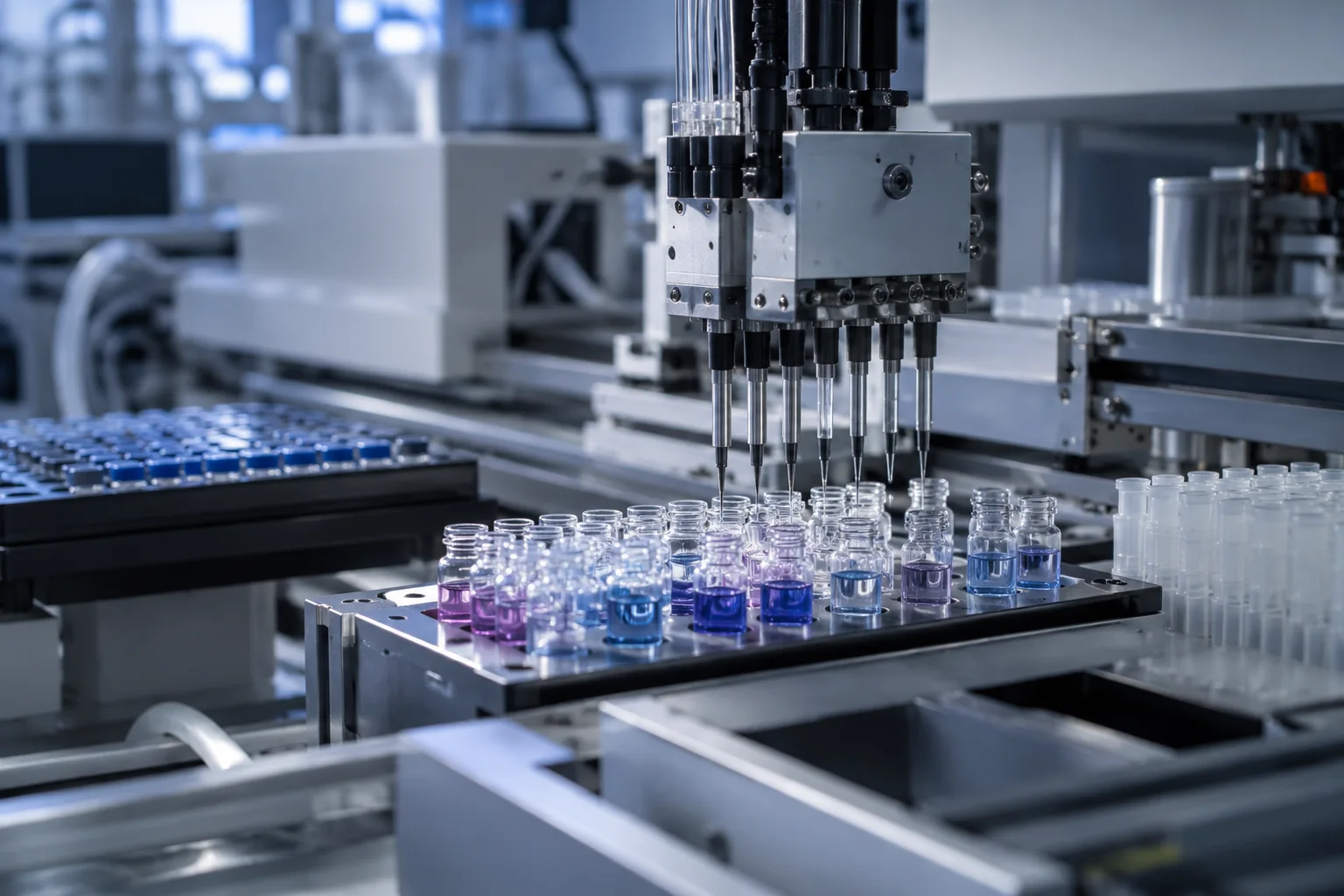
The platform combined GPT-based literature retrieval, automated synthesis and characterisation, and an A*-based optimisation loop. Researchers applied it to Au, Ag, Cu2O and PdCu nanoparticles. For multi-target gold nanorod synthesis, the study ran 735 experiments to optimise longitudinal plasmon peaks across 600–900 nm; it also reports 50 experiments for gold nanospheres and silver nanocubes. Under repeated identical gold-nanorod parameters, peak and full-width-at-half-maximum deviations were no greater than 1.1 nm and 2.9 nm, respectively.
Why it matters
It shows that a closed-loop laboratory platform can optimise selected nanoparticle syntheses with repeatable optical measurements, while making the boundary between automation and human involvement explicit.
Caveats
- Researchers still edited scripts or selected existing instrument files and entered parameters before automated runs.
- The demonstrated optimisation tasks used customised hardware and selected nanomaterials; transfer to other instruments, chemistries or laboratories was not established.
- The 735 and 50 experiment counts apply to different optimisation tasks and should not be combined as one general performance measure.
Technology profiles
Sources
- peer reviewed paper
A chemical autonomous robotic platform for end-to-end synthesis of nanoparticles
Fan Gao, Hongqiang Li, Zhilong Chen et al.. Nature Communications, 14 Aug 2025. DOI: 10.1038/s41467-025-62994-2.
Last reviewed 21 Oct 2026.