Autonomous laboratories
Also known as Self-driving laboratories, Autonomous research laboratories, Closed-loop experimental laboratories, Autonomous experimentation
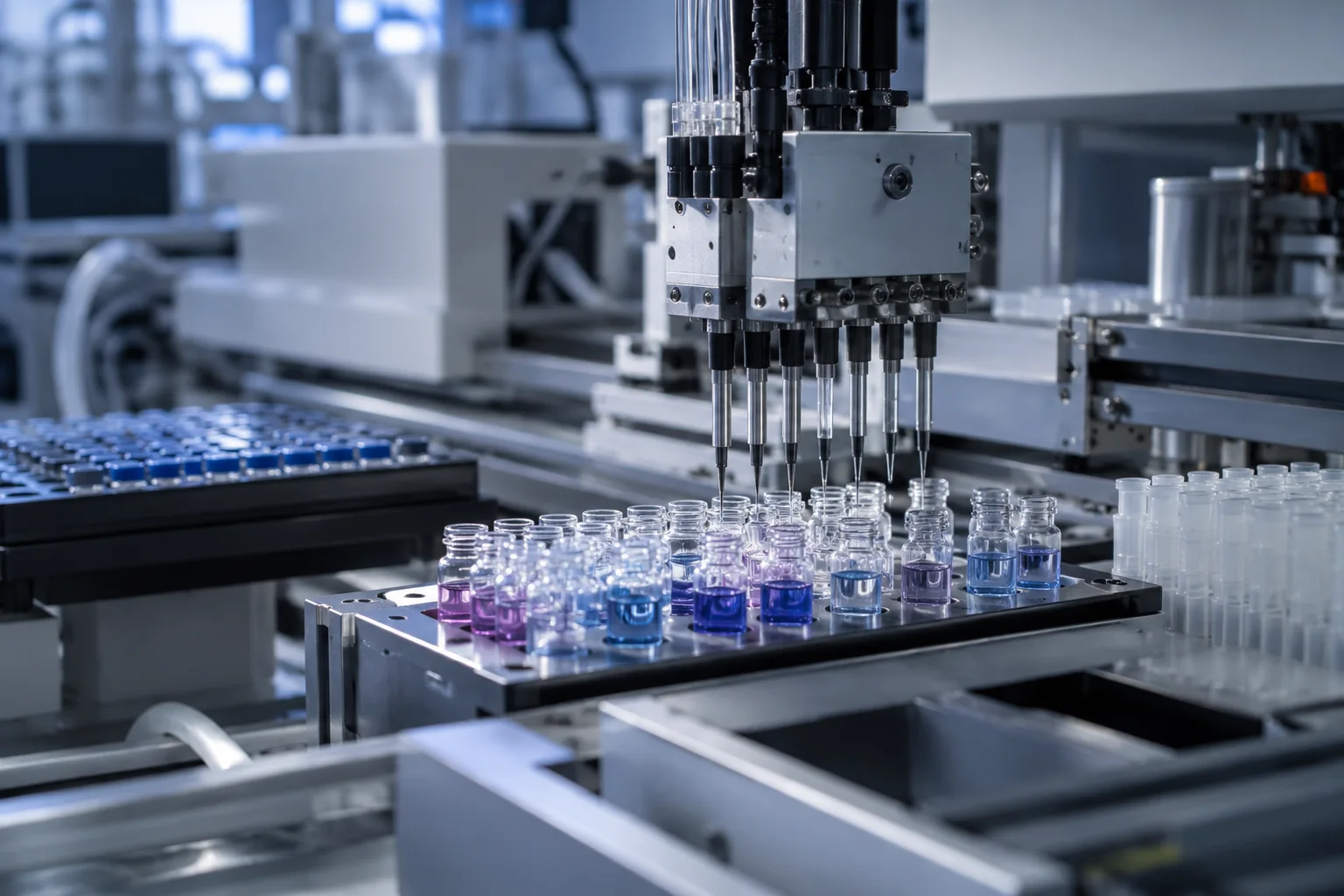
Autonomous laboratories combine automated instruments with software that selects or adapts experiments based on measured results. Research platforms have demonstrated this approach in catalyst discovery, nanoparticle synthesis, inorganic powder synthesis, multi-step fluidic chemistry, protein engineering, exploratory chemistry and optical-material screening. Their autonomy is bounded by human-defined objectives, selected candidate spaces, configured instruments and validation requirements; the examples do not show general-purpose laboratories that independently choose and verify any scientific question.
In plain language
A conventional automated laboratory follows a script written by a person. An autonomous or self-driving laboratory adds a decision loop: software receives measurements from an experiment, uses a model or set of rules to choose what to try next, and sends the next experiment to automated instruments. This can reduce repetitive work and help search a large set of possible conditions.
“Autonomous” describes a particular workflow, not the whole of science. Researchers commonly choose the scientific goal, define the materials or reactions that may be tested, set constraints, provide starting data and inspect important results. Some systems still need people to edit scripts, load materials, resolve instrument problems or confirm outputs with measurements that are not automated. The level of autonomy therefore needs to be described for each task.
Technical explanation
A typical self-driving laboratory combines a research objective, an experiment planner, automation software, laboratory instruments, measurement and analysis tools, and a feedback loop. A planner may use Bayesian optimisation, active learning, a language model, heuristics or a combination of methods to select an experiment. Robots or instrument-control software prepare and run it. Measurements are returned to the decision system, which updates its model or applies predefined criteria before proposing another experiment.
Two 2023 studies extend the range. The A-Lab combined computed stability data, literature-mined recipes, machine learning and thermodynamically guided active learning to synthesise inorganic powders, reporting results for 36 of 57 target compounds over about 17 days. AlphaFlow used reinforcement learning to direct a modular microdroplet reactor through variable multi-step reaction sequences with continuous spectral monitoring. The systems in current studies vary considerably. CRESt combines multimodal models, robotic experiments and knowledge-assisted Bayesian optimisation for electrocatalyst research. The Gao platform uses language-model-assisted literature retrieval, automated nanoparticle synthesis and A*-based parameter optimisation, but researchers still edit scripts, call files, enter parameters and use manual TEM checks. SAMPLE links protein-sequence agents to automated gene assembly, cell-free protein expression and biochemical characterisation for one glycoside-hydrolase search task. A mobile-robot chemistry platform uses existing instruments and predefined expert criteria to interpret NMR and liquid chromatography–mass spectrometry data. These examples illustrate different degrees and kinds of autonomy, rather than a single standard architecture.
What the evidence says
Each statement is typed by the strength of its evidence and linked to the source that supports it.
Demonstrated Shown in a published experiment, test or shipping product.
Autonomy in a laboratory refers to the system interpreting measurements and making decisions about subsequent experiments; a robot carrying out a fixed human-written procedure is automation, not by itself a self-driving research loop.
Sources: [4] · Introduction, paragraphs distinguishing automation from autonomyCRESt combined multimodal models, knowledge-assisted Bayesian optimisation and robotic experimentation for electrochemical formate oxidation. The article abstract reports more than 900 catalyst chemistries and 3,500 electrochemical tests over three months, and a catalyst with a reported 9.3-fold improvement in cost-specific performance in the tested eight-element chemical space.
Sources: [1] · AbstractThe Gao platform used language-model-assisted literature retrieval, automated experiments and A*-based optimisation. The study reports 735 experiments for multi-target gold nanorod optimisation and 50 for gold nanospheres and silver nanocubes. It states that human input remained necessary for script editing, file selection and parameter entry, and that targeted samples were checked manually with TEM.
Sources: [2] · Abstract; Results; Discussion; MethodsFour SAMPLE agents searched a 1,352-sequence glycoside-hydrolase landscape. In the automated platform assay, each found sequences at least 12 °C more stable than starting sequences while sampling less than 2% of the landscape; later human validation found smaller gains under different expression and assay conditions.
Sources: [3] · Abstract; Results, “Human characterization of machine-designed proteins”A mobile-robot chemistry platform linked an automated synthesis station to shared UPLC-MS and benchtop NMR instruments. Its decision-maker applied domain-expert-defined criteria to the measurements; the authors state that experts selected the reactions and building blocks before the autonomous synthesis experiments.
Sources: [4] · Abstract; Results, “Modular robotic workflow”A 2026 self-driving-laboratory study computationally screened 252 potential organic laser-emitter candidates and advanced 51 fluorene-based molecules to experimental screening, reporting tunable emissions and optical-amplification results for selected compounds.
Sources: [5] · Results, “SDL workflow and candidate exploration”; DiscussionThe A-Lab, an autonomous platform for solid-state synthesis of inorganic powders, combined computed stability data, literature-mined recipes, machine learning and thermodynamically guided active learning. The paper reports that over about 17 days it synthesised 36 of 57 target compounds, including a variety of oxides and phosphates.
Sources: [7] · AbstractA Nature Author Correction published in January 2026 states that concerns were raised about the unambiguous identification of A-Lab compound structures from diffraction data, and that the original material novelty claims were misinterpreted: the materials were new to the prediction platform, not necessarily new to science.
Sources: [8] · Author Correction noticeAlphaFlow combined reinforcement learning with a modular microdroplet reactor that ran variable sequences of reaction steps, phase separation, washing and continuous spectral monitoring. Applied to shell growth of core-shell semiconductor nanoparticles, with up to 40 parameters, it found a multi-step route that outperformed conventional sequences in the tested case.
Sources: [9] · AbstractThe SAMPLE paper reports that its four agents showed individual differences in search behaviour, yet all four converged on thermostable enzymes.
Sources: [3] · AbstractReported, unverified Stated by a company or team but not independently confirmed.
A 2025 peer-reviewed perspective describes self-driving laboratories as working towards human-defined objectives and identifies substantial development and maintenance effort, access, coordination, data-quality and standardisation challenges.
Sources: [6] · Abstract; Introduction; sections on centralised and distributed SDLs and roadblocks · medium confidenceLimitations and open problems
- Autonomy is task-bounded. Researchers define the objective, candidate materials or reactions, constraints, protocols and success criteria in the cited demonstrations.
- The workflow depends on the instruments, models and measurements it has been configured to use. Results in one reaction or material space do not establish general performance in another laboratory or scientific domain.
- Human input remains part of several workflows. The nanoparticle platform requires script editing, file selection and parameter entry, and researchers manually checked selected samples with transmission electron microscopy. SAMPLE researchers manually validated the top designs and found smaller thermostability gains than the automated setup.
- A system may optimise a measurable proxy such as a spectral peak or assay result without demonstrating that the optimised material has useful device, production or clinical performance.
- Reliable operation needs calibration, quality control, reproducibility checks, maintenance, safe process design, good data handling and skilled staff. A 2025 perspective notes substantial development and maintenance effort and unresolved access, coordination and standards questions.
- The reported research platforms are prototypes or task-specific installations. The cited evidence does not establish a general-purpose laboratory that independently originates, conducts and validates arbitrary scientific research.
- The A-Lab paper was corrected in January 2026. The correction states that concerns were raised about how compound structures were identified from diffraction data, and that its novelty claims referred to materials new to the prediction platform, not necessarily new to science. Identification of compound structures from diffraction data needs independent checks before results are treated as new materials.
Possible future uses
Ideas, not predictions. None of these has been demonstrated.
- Research groups could use shared or distributed self-driving facilities to make advanced experimentation available to more teams, if costs, support, interoperability, data quality and access are addressed.
- Closed-loop platforms could help optimise selected manufacturing formulations, biological assays, catalysts or energy materials; benefits need to be evaluated for each workflow and endpoint.
- Scientific agents may eventually coordinate more stages of hypothesis generation and experimental work, but broad scientific independence is not demonstrated by the cited task-specific systems.
Timeline
- 14 Mar 2023AlphaFlow reported reinforcement-learning guided multi-step chemistry in a self-driven fluidic lab, applied to core-shell semiconductor nanoparticles. Sources: [9]
- 29 Nov 2023The A-Lab reported autonomous solid-state synthesis of inorganic powders, with 36 of 57 target compounds synthesised over about 17 days. Sources: [7]
- 11 Jan 2024SAMPLE research reported four protein-engineering agents using automated design-test-learn cycles for a defined glycoside-hydrolase landscape. Sources: [3]
- 6 Nov 2024A mobile-robot platform demonstrated exploratory synthetic chemistry using shared laboratory instruments and multiple measurement types. Sources: [4]
- 24 Apr 2025A peer-reviewed perspective reviewed self-driving laboratories, access models and development and maintenance challenges. Sources: [6]
- 14 Aug 2025A nanoparticle platform reported automated optimisation across multiple nanomaterial synthesis tasks, with manual script, file and parameter input. Sources: [2]
- 23 Sept 2025CRESt reported multimodal robotic electrocatalyst discovery with more than 900 chemistries and 3,500 electrochemical tests over three months. Sources: [1]
- 19 Jan 2026Nature published an Author Correction to the A-Lab paper, clarifying that its novelty claims meant materials new to the prediction platform rather than necessarily new to science. Sources: [8]
- 19 Feb 2026A self-driving laboratory study reported screening of 51 organic laser-emitter candidates selected from a computational library of 252 candidates. Sources: [5]
Futures this could help bring about
Related breakthroughs
- CRESt platform screens more than 900 catalyst chemistries in three months (23 Sept 2025)
- Automated platform optimises nanoparticle synthesis across hundreds of experiments (14 Aug 2025)
- Four SAMPLE agents find more thermostable glycoside hydrolases while sampling under 2% of a sequence landscape (11 Jan 2024)
Glossary
- Closed-loop experiment
- A sequence in which results from one experiment inform the selection or design of a later experiment.
- Active learning
- A modelling approach that chooses new examples or experiments to reduce uncertainty or improve a specified objective.
- Automation
- Using equipment or software to carry out defined steps with limited manual operation; automation alone does not mean the system chooses what to do next.
- Self-driving laboratory
- A laboratory workflow that combines automated experiments with computational selection or adaptation of experiments based on results, usually within a human-defined research objective.
- X-ray diffraction (XRD)
- A method that uses the scattering of X-rays to infer crystalline structure and phases in a sample.
- Design-build-test-learn
- A cycle that proposes designs, physically produces them, measures outcomes and uses those results to guide future designs.
- Assay
- A measurement designed to quantify a biological or chemical property.
Sources
- peer reviewed paper
A multimodal robotic platform for multi-element electrocatalyst discovery
Zhen Zhang, Zhichu Ren, Chia-Wei Hsu et al.. Nature, 23 Sept 2025. DOI: 10.1038/s41586-025-09640-5. Accessed 21 Oct 2026. - peer reviewed paper
A chemical autonomous robotic platform for end-to-end synthesis of nanoparticles
Fan Gao, Hongqiang Li, Zhilong Chen et al.. Nature Communications, 14 Aug 2025. DOI: 10.1038/s41467-025-62994-2. Accessed 21 Oct 2026. - peer reviewed paper
Self-driving laboratories to autonomously navigate the protein fitness landscape
Jacob T. Rapp, Bennett J. Bremer, Philip A. Romero. Nature Chemical Engineering, 11 Jan 2024. DOI: 10.1038/s44286-023-00002-4. Accessed 21 Oct 2026. - peer reviewed paper
Autonomous mobile robots for exploratory synthetic chemistry
Tianwei Dai, Sriram Vijayakrishnan, Filip T. Szczypiński et al.. Nature, 6 Nov 2024. DOI: 10.1038/s41586-024-08173-7. Accessed 21 Oct 2026. - peer reviewed paper
Discovery of tunable and soluble organic emitters for solid-state lasers with a self-driving laboratory
Hyun Suk Park, Mahdi Mazaheri, Changhyeok Choi et al.. Nature Communications, 19 Feb 2026. DOI: 10.1038/s41467-026-69233-2. Accessed 21 Oct 2026. - review article
Science acceleration and accessibility with self-driving labs
Richard B. Canty, Jeffrey A. Bennett, Keith A. Brown et al.. Nature Communications, 24 Apr 2025. DOI: 10.1038/s41467-025-59231-1. Accessed 21 Oct 2026. - peer reviewed papercorrected
An autonomous laboratory for the accelerated synthesis of inorganic materials
Nathan J. Szymanski, Bernardus Rendy, Yuxing Fei et al.. Nature, 29 Nov 2023. DOI: 10.1038/s41586-023-06734-w. Accessed 21 Oct 2026. - other
Author Correction: An autonomous laboratory for the accelerated synthesis of inorganic materials
Nature, 19 Jan 2026. DOI: 10.1038/s41586-025-09992-y. Accessed 21 Oct 2026. - peer reviewed paper
AlphaFlow: autonomous discovery and optimization of multi-step chemistry using a self-driven fluidic lab guided by reinforcement learning
Amanda A. Volk, Robert W. Epps, Daniel T. Yonemoto et al.. Nature Communications, 14 Mar 2023. DOI: 10.1038/s41467-023-37139-y. Accessed 21 Oct 2026.
Revision history
5 changes since this profile was created.