How far are we from AI-designed medicines reaching patients?
One AI-designed small molecule, rentosertib, has published results from a randomised phase 2a trial in 71 patients with idiopathic pulmonary fibrosis, a lung disease. The trial was small. Its primary endpoint was safety and tolerability, and lung function was a secondary endpoint, so a clinical benefit is not yet established. The sources reviewed show no AI-designed medicine approved for use.
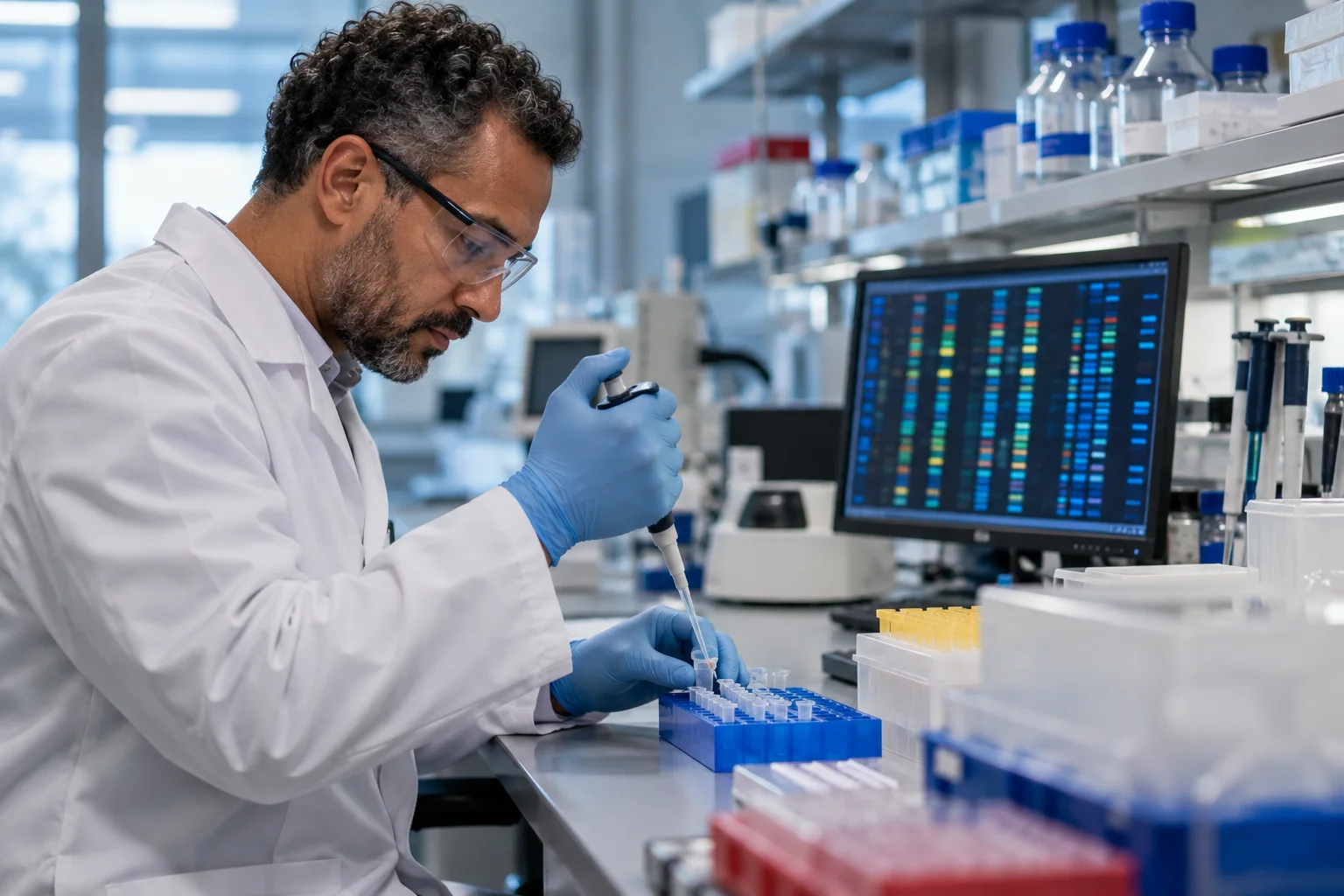
Close. Early pilots are running in the real world.
Rentosertib has completed a randomised phase 2a trial, and its results are published in Nature Medicine. That places it in early clinical testing in patients. The sources reviewed show no phase 3 result and no regulatory approval for an AI-designed medicine, so the stage is pilot rather than scaling.
The tech tree
Everything recorded on Vrulum that this future needs, oldest foundations at the top and the goal at the bottom. Lines show what each step requires.
- 2016Base and prime gene editingResearch and prototypes Being researched.
- 2021AI protein structure predictionResearch and prototypes Being researched.
- 2016Base editing tool describedDone Unlocked.
- 2021Protein structure prediction publishedDone Unlocked.
- 2024Early trial success rates for AI-discovered molecules reviewedDone Unlocked.
- 2025Randomised phase 2a trial in idiopathic pulmonary fibrosisDone Unlocked.
- Date not recordedCandidate medicine designed with a generative AI platformDone Unlocked.
- Date not recordedPhase 3 trialNot started Locked.
- Date not recordedRegulatory approval of an AI-designed medicineNot started Locked.
- Date not recordedRoutine clinical useNot started Locked.
- GoalAI-designed medicines reaching patientsGoalRequires: Base and prime gene editing, AI protein structure prediction, Base editing tool described, Protein structure prediction published, Candidate medicine designed with a generative AI platform, Early trial success rates for AI-discovered molecules reviewed, Randomised phase 2a trial in idiopathic pulmonary fibrosis, Phase 3 trial, Regulatory approval of an AI-designed medicine, Routine clinical use. Locked.
The road so far
5 of 8 steps done.
- Done · 20 Apr 2016Base editing tool described
Komor and colleagues described a base editor that converts one DNA base into another without double-stranded DNA cleavage. Base editing is one of the technologies this page links to. [4]
- Done · 15 Jul 2021Protein structure prediction published
AlphaFold, a system for predicting protein structures, was published in Nature. It is a structure prediction tool, not a medicine. [3]
- DoneCandidate medicine designed with a generative AI platform
Rentosertib (ISM001-055), a TNIK inhibitor, was discovered and designed with Insilico Medicine's generative AI platform, according to the paper and the company announcement. [1][2]
- Done · Jun 2024Early trial success rates for AI-discovered molecules reviewed
A 2024 analysis reported an 80-90% success rate in Phase I for AI-discovered molecules and about 40% in Phase II. The Phase II figure is comparable to historic averages and rests on a small sample. [5]
- Done · 3 Jun 2025Randomised phase 2a trial in idiopathic pulmonary fibrosis
The trial enrolled 71 patients across four arms, at 22 sites in China according to the sponsor's announcement. At 12 weeks, the 60 mg once-daily group had a mean FVC change of +98.4 mL (95% confidence interval 10.9 to 185.9), against -20.3 mL for placebo, as reported in the paper. The primary endpoint was safety and tolerability; FVC was a secondary endpoint. [1][2]
- Not startedPhase 3 trial
No phase 3 results appear in the sources reviewed.
- Not startedRegulatory approval of an AI-designed medicine
No approval appears in the sources reviewed.
- Not startedRoutine clinical use
Needs regulatory approval, manufacturing at scale and a track record across several drugs.
Why it matters
If AI tools can design medicines faster or with fewer failed candidates, people with diseases that have few good treatments could benefit sooner. The current evidence does not yet show this. Early-stage success rates for AI-discovered molecules look high in Phase I, but the Phase II rate is close to historic averages. Results from larger trials will show whether AI changes outcomes or mainly speeds up the early work.
What stands in the way
- Small trials: the phase 2a trial had 71 patients across four arms, too few to confirm a lung function effect.
- Trial aims: the primary endpoint was safety and tolerability, so the lung function result is secondary and not confirmatory.
- Discontinuations: the paper's abstract names liver toxicity and diarrhoea as the most common events leading to treatment discontinuation.
- Phase II rate: analysis puts it at about 40% for AI-discovered molecules, comparable to historic averages.
- Company reporting: the sponsor issued its own announcement of the results, so independent confirmation is needed in larger trials.
Signals to watch
- Phase 3 registration and results for rentosertib, with efficacy as the primary endpoint.
- Updated success-rate analyses for AI-discovered molecules, with larger sample sizes.
- Independent replication of the lung function effect in a second trial.
- Published safety data from larger trials, including liver findings.
- A regulator approves a medicine whose discovery is documented as AI-led.
Sources
- peer reviewed paper
A generative AI-discovered TNIK inhibitor for idiopathic pulmonary fibrosis: a randomized phase 2a trial
Zuojun Xu, Feng Ren, Ping Wang et al.. Nature Medicine (Springer Nature), 3 Jun 2025. - company announcement
Insilico Medicine announces Nature Medicine publication of phase IIa results evaluating rentosertib, the novel TNIK inhibitor for idiopathic pulmonary fibrosis
Insilico Medicine (company announcement, distributed via BioSpace), 3 Jun 2025. - peer reviewed paper
Highly accurate protein structure prediction with AlphaFold
John Jumper, Richard Evans, Alexander Pritzel et al.. Nature (Springer Nature), 15 Jul 2021. - peer reviewed paper
Programmable editing of a target base in genomic DNA without double-stranded DNA cleavage
Alexis C. Komor, Yongjoo B. Kim, Michael S. Packer et al.. Nature (Springer Nature), 20 Apr 2016. - review article
How successful are AI-discovered drugs in clinical trials? A first analysis and emerging lessons
KP Jayatunga, Ayers, Bruens et al.. Drug Discovery Today (Elsevier), Jun 2024.
Last reviewed 21 Oct 2026.