AI protein structure prediction
Also known as Protein structure prediction, AlphaFold, Deep-learning protein folding
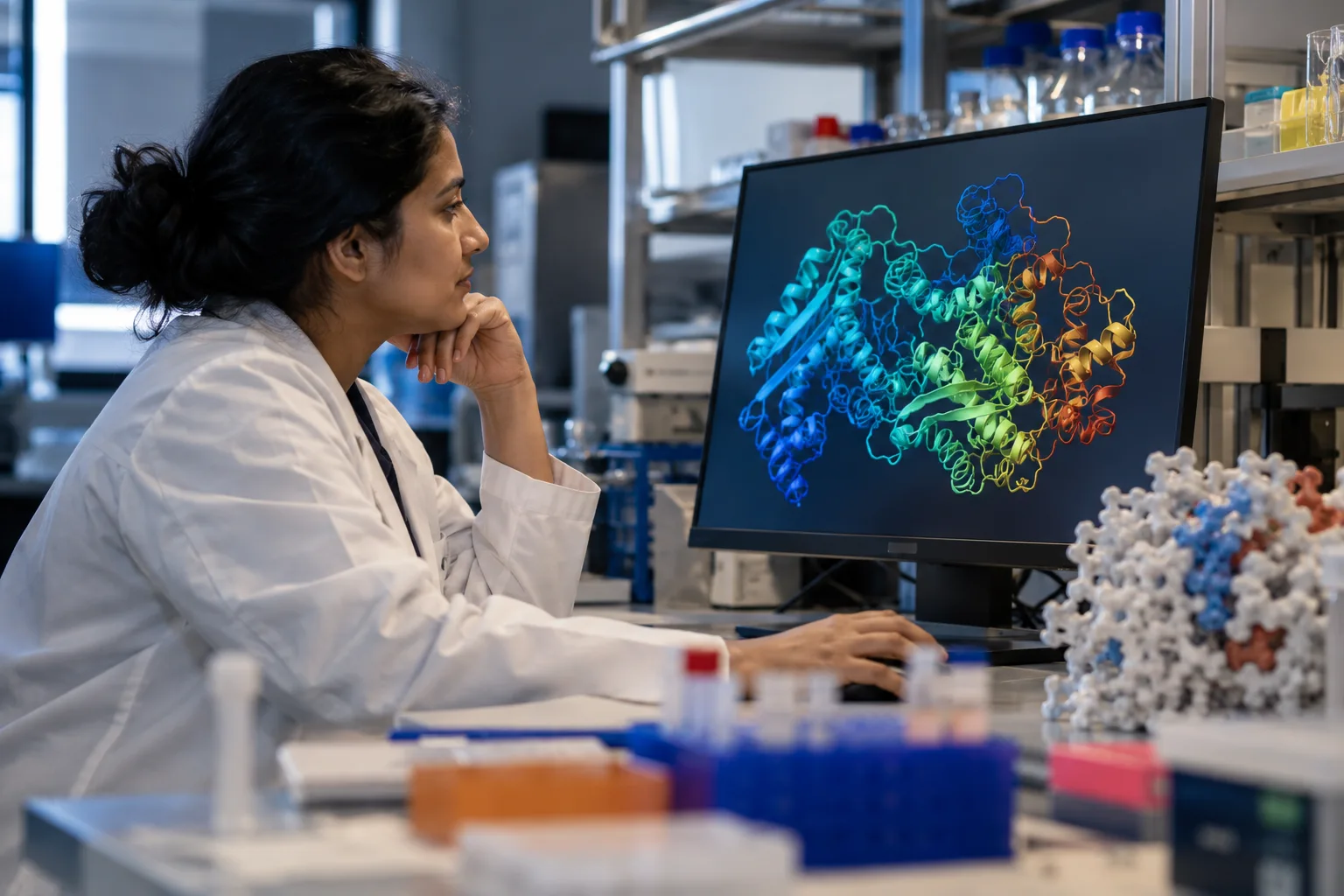
AI systems can now predict the three-dimensional shape of many proteins from their amino acid sequence, often with accuracy close to experimental methods. The clearest evidence is for single proteins. Accuracy for flexible proteins, complexes and proteins with few known relatives is less well established.
In plain language
A protein is a chain of amino acids that folds into a specific three-dimensional shape, and that shape largely determines what the protein does. For decades, finding the shape meant growing crystals or running slow lab experiments, which can take months or years for a single protein.
AI systems trained on known protein structures can now take a sequence of amino acids and predict the likely shape in minutes. In a 2020 international test called CASP14, one deep-learning system produced predictions that the assessors said rivalled experimental structures in accuracy for single proteins. Researchers now use these predictions to study proteins whose shapes were never measured, though the predictions are still models and need checking.
Technical explanation
Modern structure predictors combine a large evolutionary search over related sequences, usually as a multiple sequence alignment, with a neural network that predicts distances and angles between residues. The AlphaFold2 paper by Jumper and colleagues (2021) described an end-to-end network of this kind and reported accuracy competitive with experimental structures in a majority of cases. A separate three-track network described by Baek and colleagues in Science (2021) reached accuracies approaching those of the DeepMind system in CASP14 and extended the approach to protein-protein interactions.
The field has moved from single chains to wider coverage and complexes. The AlphaFold Protein Structure Database, described by Varadi and colleagues in Nucleic Acids Research (published online 2021, issue dated 2022), initially contained over 360,000 predicted structures across 21 model-organism proteomes. AlphaFold 3 (Abramson, Jumper and colleagues, Nature, 2024) extends prediction to complexes that include ligands, nucleic acids, ions, modified residues and antibodies, and the authors report substantially higher accuracy than many specialised tools on the benchmarks they used. These accuracy figures come from the developers' own evaluations and have not been independently reproduced in the sources reviewed here.
The CASP14 assessors qualified their conclusion: the results represent a solution to the classical folding problem at least for single proteins. Accuracy for other kinds of protein and for complexes is less well established in the sources reviewed here.
What the evidence says
Each statement is typed by the strength of its evidence and linked to the source that supports it.
Demonstrated Shown in a published experiment, test or shipping product.
In CASP14, deep-learning methods from one research group consistently delivered computed structures that rivalled experimental structures in accuracy, according to the CASP assessors.
Sources: [3] · AbstractAlphaFold2 reached accuracy competitive with experimental structures in a majority of cases.
Sources: [1] · AbstractA three-track neural network reached accuracies approaching those of the DeepMind system in CASP14, and the same approach predicts protein-protein interactions.
Sources: [2] · Abstract · medium confidenceThe initial release of the AlphaFold Protein Structure Database contained over 360,000 predicted structures across 21 model-organism proteomes.
Sources: [4] · AbstractReported, unverified Stated by a company or team but not independently confirmed.
AlphaFold 3 shows substantially improved accuracy over many previous specialised tools, including far greater accuracy for protein-ligand interactions than state-of-the-art docking tools, as reported by its developers.
Sources: [5] · Abstract · medium confidenceAlphaFold 3 reports much higher accuracy for protein-nucleic acid interactions than nucleic-acid-specific predictors, according to the authors' benchmarks.
Sources: [5] · Abstract · medium confidenceLimitations and open problems
- The CASP14 assessors' conclusion applies at least to single proteins, so accuracy for other kinds of structure is less well established (Kryshtafovych and colleagues, 2021).
- The AlphaFold2 paper reports accuracy competitive with experimental structures in a majority of cases, not in every case (Jumper and colleagues, 2021).
- The AlphaFold 3 accuracy figures are reported by its developers on their own benchmarks and have not been independently reproduced in the sources reviewed (Abramson and colleagues, 2024).
- The initial AlphaFold Protein Structure Database release covered 21 model-organism proteomes, not the full set of known sequences (Varadi and colleagues, 2021).
Possible future uses
Ideas, not predictions. None of these has been demonstrated.
- Faster first-pass screening of drug targets for which no experimental structure exists.
- Designing new proteins with chosen shapes for enzymes or industrial materials.
- Predicting protein-drug complexes early in drug discovery, if independent tests confirm the accuracy reported for AlphaFold 3.
Timeline
- 15 Jul 2021Jumper and colleagues publish AlphaFold2 in Nature, reporting accuracy competitive with experimental structures in a majority of cases. Sources: [1]
- 15 Jul 2021Baek and colleagues publish a three-track neural network for protein structures and interactions in Science. Sources: [2]
- 7 Oct 2021The CASP14 assessment report in Proteins states that deep-learning predictions rivalled experimental structures in accuracy for single proteins. Sources: [3]
- 17 Nov 2021Varadi and colleagues publish the AlphaFold Protein Structure Database paper in Nucleic Acids Research; the initial release contained over 360,000 predicted structures. Sources: [4]
- 8 May 2024Abramson, Jumper and colleagues publish AlphaFold 3 in Nature, extending prediction to ligands, nucleic acids and antibodies. Sources: [5]
Futures this could help bring about

Related breakthroughs
Glossary
- Protein folding
- The process by which a chain of amino acids takes up a specific three-dimensional shape.
- CASP
- The Critical Assessment of Structure Prediction, a blind international test in which teams predict protein structures that are not yet public.
- pLDDT
- A per-residue confidence score used by AlphaFold, where higher values indicate more reliable local predictions.
- Multiple sequence alignment
- An arrangement of related protein sequences that shows which positions tend to change together, giving clues about how residues are packed in the structure.
Sources
- peer reviewed paper
Highly accurate protein structure prediction with AlphaFold
John Jumper, Richard Evans, Alexander Pritzel et al.. Nature, 15 Jul 2021. DOI: 10.1038/s41586-021-03819-2. Accessed 21 Oct 2026. - peer reviewed paper
Accurate prediction of protein structures and interactions using a three-track neural network
Minkyung Baek, David Baker. Science, 15 Jul 2021. DOI: 10.1126/science.abj8754. Accessed 21 Oct 2026. - review article
Critical assessment of methods of protein structure prediction (CASP)-Round XIV
Andriy Kryshtafovych, John Moult. Proteins, 7 Oct 2021. DOI: 10.1002/prot.26237. Accessed 21 Oct 2026. - peer reviewed paper
AlphaFold Protein Structure Database: massively expanding the structural coverage of protein-sequence space with high-accuracy models
Mihaly Varadi, Sameer Velankar. Nucleic Acids Research, 17 Nov 2021. DOI: 10.1093/nar/gkab1061. Accessed 21 Oct 2026. - peer reviewed paper
Accurate structure prediction of biomolecular interactions with AlphaFold 3
J. Abramson, John M. Jumper. Nature, 8 May 2024. DOI: 10.1038/s41586-024-07487-w. Accessed 21 Oct 2026.
Revision history
3 changes since this profile was created.