How far are we from brain-computer interfaces for everyday use?
Brain-computer interfaces that read neural signals to control computers now work in small numbers of people, mostly through implanted electrodes. A 2023 study decoded attempted speech from electrodes in the brain of a participant who could not speak intelligibly, and a 2024 trial of a blood-vessel implant met its one-year safety endpoint in six people. These devices remain in research studies, and no implanted interface is yet in routine use.
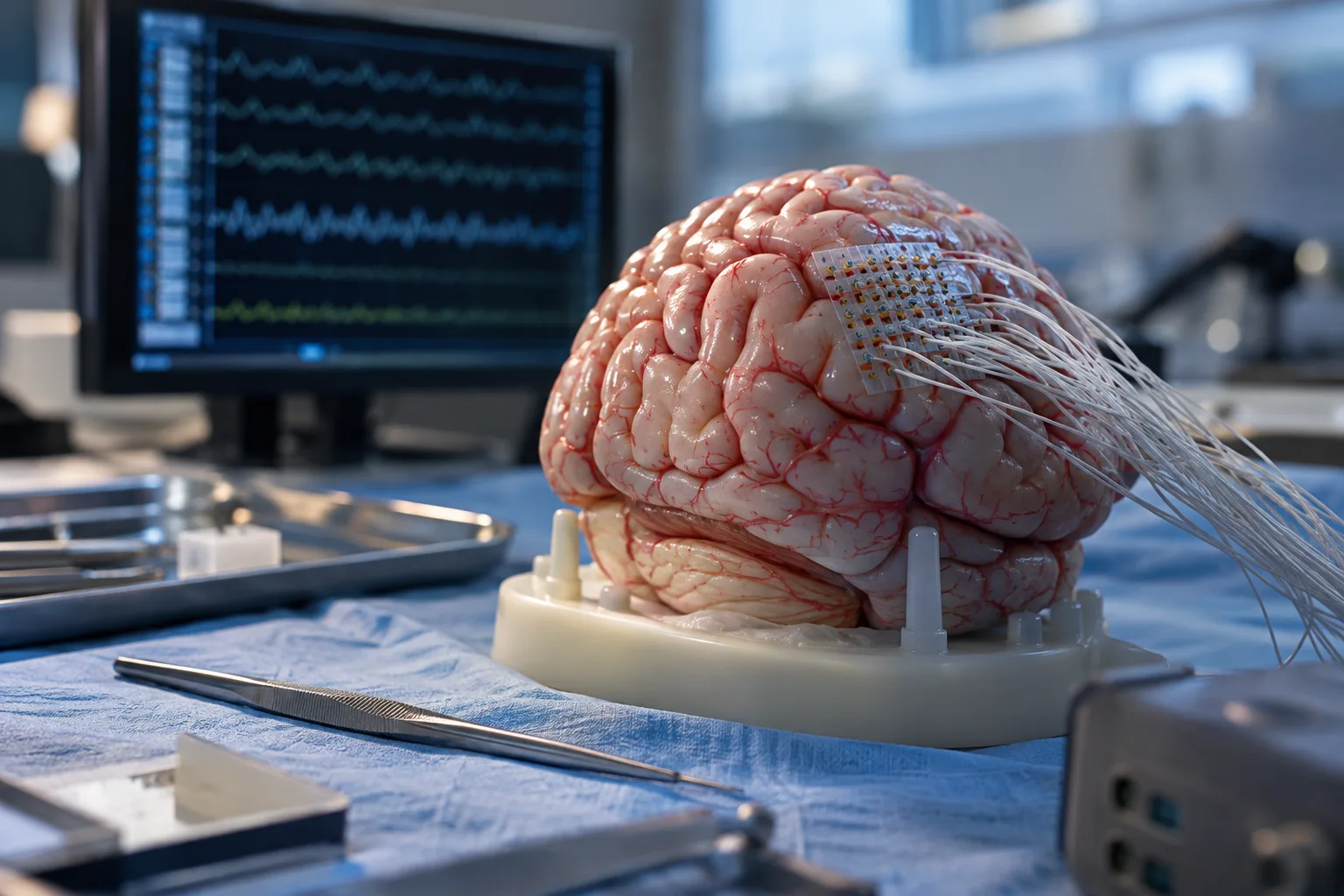
Close. Early pilots are running in the real world.
Implanted interfaces have moved from laboratory work into human trials. Willett and colleagues reported speech decoding in a participant with paralysis in 2023, and Synchron reported that all six participants in its US early feasibility trial met the one-year safety endpoint. These studies are small. No peer-reviewed paper for the Synchron trial was identified in the sources reviewed, and no implanted interface is shown to be in routine clinical or consumer use. That fits the pilot stage.
The tech tree
Everything recorded on Vrulum that this future needs, oldest foundations at the top and the goal at the bottom. Lines show what each step requires.
- 2012Bioresorbable (transient) electronicsResearch and prototypes Being researched.
- 2017High-density neural probesResearch and prototypes Being researched.
- 2019Brain-computer interfacesPilot and early commercial Unlocked.
- 2012Decoding movement intent from brain signalsDone Unlocked.
- 2020Implant placed through blood vessels in humansDone Unlocked.
- 2023Decoding speech from brain signalsDone Unlocked.
- 2024Early feasibility trial of a permanent implant in the United StatesDone Unlocked.
- Date not recordedLarger controlled trialsNot started Locked.
- Date not recordedLong-term reliability in everyday settingsNot started Locked.
- Date not recordedRegulatory approval for routine useNot started Locked.
- Date not recordedWidespread everyday useNot started Locked.
- GoalBrain-computer interfaces for everyday useGoalRequires: Brain-computer interfaces, Bioresorbable (transient) electronics, High-density neural probes, Decoding movement intent from brain signals, Decoding speech from brain signals, Implant placed through blood vessels in humans, Early feasibility trial of a permanent implant in the United States, Larger controlled trials, Long-term reliability in everyday settings, Regulatory approval for routine use, Widespread everyday use. Locked.
The road so far
4 of 8 steps done.
- Done · 16 May 2012Decoding movement intent from brain signals
Hochberg and colleagues showed that people with tetraplegia could reach and grasp with a robotic arm controlled by signals recorded from the motor cortex. The work was reported in Nature in 2012 and was carried out in two participants. [1]
- Done · 23 Aug 2023Decoding speech from brain signals
Willett and colleagues reported an intracortical implant that decoded attempted speech into text for a participant who could not speak intelligibly. The work was published in Nature in 2023. [2]
- Done · 28 Oct 2020Implant placed through blood vessels in humans
Oxley and colleagues described a stent-electrode device implanted in the superior sagittal sinus, next to the motor cortex, using a minimally invasive neurointervention rather than open brain surgery. Two participants with ALS were implanted in the first-in-human study, which was published in the Journal of NeuroInterventional Surgery. [3]
- Done · 30 Sept 2024Early feasibility trial of a permanent implant in the United States
Six people with severe chronic paralysis in both upper limbs received Synchron's endovascular implant. All six met the primary endpoint of no device-related serious adverse events resulting in death or permanent increased disability over one year. The results were presented at the 2024 Congress of Neurological Surgeons and announced in a company release, reprinted on Neurofounders. No peer-reviewed publication was cited in the release. [4]
- Not startedLarger controlled trials
Effectiveness and long-term safety need trials with more participants and comparison groups. No such trial result was identified in the sources reviewed.
- Not startedLong-term reliability in everyday settings
Electrodes in brain tissue or blood vessels can change over time as the body responds to them. Multi-year data on how well devices work in people's homes are not yet available in the sources reviewed.
- Not startedRegulatory approval for routine use
A regulator would need to approve an implanted interface for sale or routine clinical use. None had done so in the sources reviewed.
- Not startedWidespread everyday use
Wide use would need approved devices, reimbursement, manufacturing at scale and devices that work reliably outside specialist clinics.
Why it matters
Paralysis from stroke, motor neurone disease or spinal cord injury can take away the ability to speak, write or use a computer. A reliable interface could restore some of those abilities. Wider use would also raise questions about consent, the privacy of brain data, cost and who gets access.
What stands in the way
- The most capable implants need surgery, which limits who can receive them and carries risks of infection and bleeding.
- Trials so far have very small numbers of participants, so safety and benefit across different users are not yet known.
- Signals recorded from implants can change over time, so decoding systems need recalibration.
- Regulators need long-term safety data and clear evidence of benefit before approving devices for routine use.
- Rules on consent, ownership and protection of neural data are still being developed.
Signals to watch
- Peer-reviewed publication of the Synchron COMMAND trial, with full methods and adverse event data.
- Trials that enrol more participants and include comparison groups.
- Regulatory authorisation of an implanted interface for routine use, as opposed to research use.
- Multi-year reports of devices working in people using them at home.
- Speech or movement decoding reported in more people with different conditions.
Sources
- peer reviewed paper
Reach and grasp by people with tetraplegia using a neurally controlled robotic arm
Leigh R. Hochberg. Nature, 16 May 2012. - peer reviewed paper
A high-performance speech neuroprosthesis
Francis R. Willett, Erin M. Kunz, Chaofei Fan. Nature, 23 Aug 2023. - peer reviewed paper
Motor neuroprosthesis implanted with neurointerventional surgery improves capacity for activities of daily living tasks in severe paralysis: first in-human experience
Thomas J. Oxley. Journal of NeuroInterventional Surgery, 28 Oct 2020. - company announcement
Synchron Announces Positive Results from U.S. COMMAND Study of Endovascular Brain-Computer Interface
Synchron (company announcement), 30 Sept 2024.
Last reviewed 21 Oct 2026.