How close is protein made by microbes from CO2, hydrogen and electricity to being a common food ingredient?
Microbes can grow on carbon dioxide and hydrogen, and some of their biomass can be dried into a protein powder. One company reports a plant, Factory 01, with a design capacity of 160 tonnes a year, and Singapore has approved its protein for food use. In the United States and the European Union, regulatory reviews of the same protein are still open, and the company expects decisions in 2026. Independent data on cost and on the full energy and land balance are not yet published, so the protein is not yet a common ingredient.
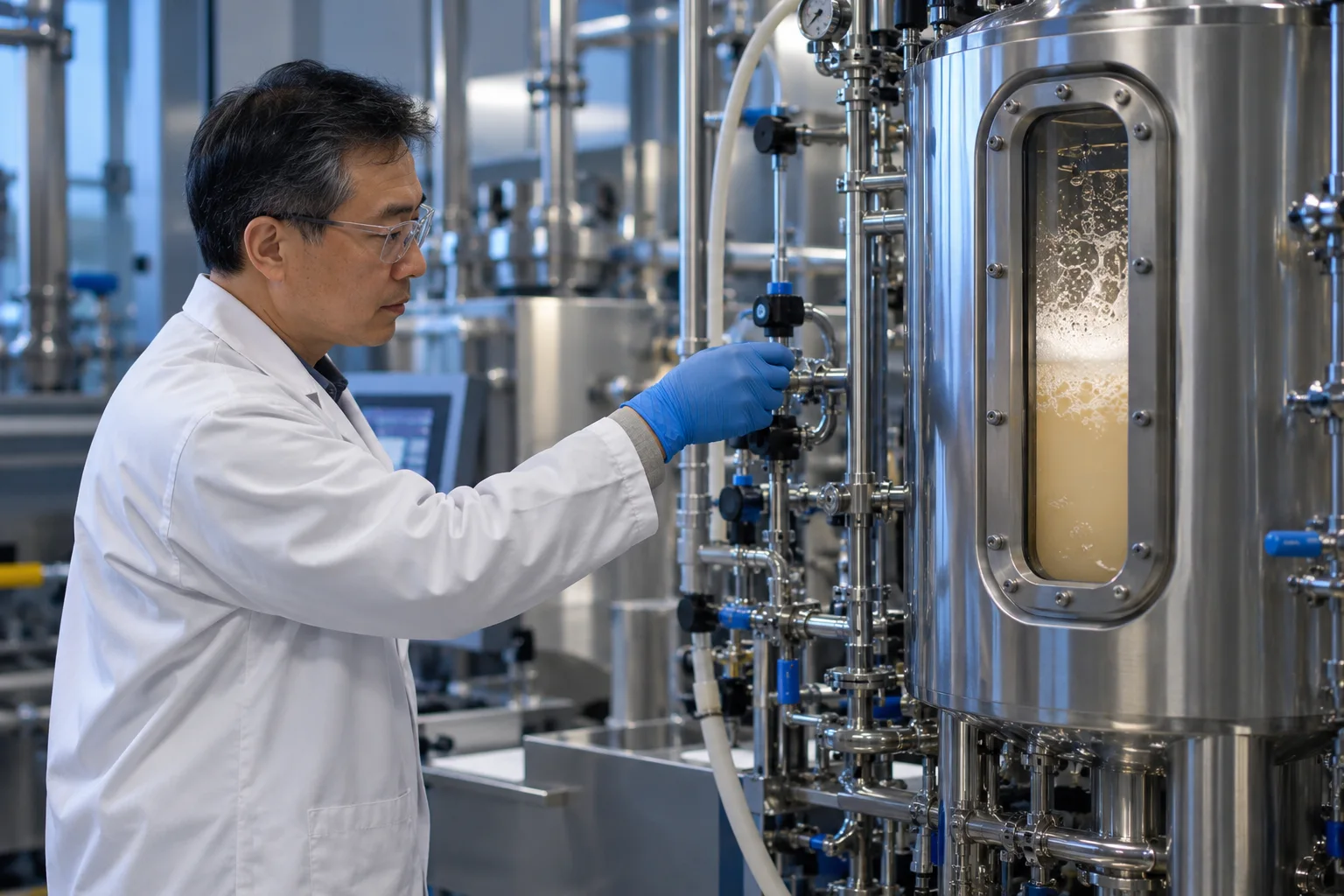
Close. Early pilots are running in the real world.
A single plant is reported to run at a design capacity of 160 tonnes a year, and the company describes it as producing continuously, but the output and productivity figures come from company releases and have not been independently verified. The protein is approved for food in Singapore and is in US and EU regulatory review. No independent techno-economic or full life-cycle assessment for this route was found in the sources opened, so the stage is pilot rather than scaling.
The tech tree
Everything recorded on Vrulum that this future needs, oldest foundations at the top and the goal at the bottom. Lines show what each step requires.
- 2016Direct air capture of CO2Pilot and early commercial Unlocked.
- 2020Precision fermentationPilot and early commercial Unlocked.
- 2021Protein made from air and electricityPilot and early commercialRequires: Electrolysers for low-carbon hydrogen. Unlocked.
- 2021Growing microbes on carbon dioxide and hydrogen in the laboratoryDone Unlocked.
- 2022Food-use approval in SingaporeDone Unlocked.
- 2024US self-affirmed GRAS statusDone Unlocked.
- 2025EU novel food reviewIn progress Being researched.
- 2025FDA review of the GRAS notificationIn progress Being researched.
- 2025Factory 01 operating in FinlandDone Unlocked.
- Date not recordedFactory 01 expanded to 230 tonnes a yearNot started Locked.
- Date not recordedSecond factoryNot started Locked.
- GoalFood made from air and electricityGoalRequires: Protein made from air and electricity, Precision fermentation, Electrolysers for low-carbon hydrogen, Direct air capture of CO2, Growing microbes on carbon dioxide and hydrogen in the laboratory, Food-use approval in Singapore, Factory 01 operating in Finland, US self-affirmed GRAS status, FDA review of the GRAS notification, EU novel food review, Factory 01 expanded to 230 tonnes a year, Second factory. Locked.
The road so far
4 of 8 steps done, 2 in progress.
- Done · 30 Aug 2021Growing microbes on carbon dioxide and hydrogen in the laboratory
A peer-reviewed study tested hydrogen-oxidising and methane-oxidising bacteria in co-culture on biogas and hydrogen. The authors estimated that adding air raised biomass yield by 14 per cent and cut CO2 emissions from 3.0 to 2.4 kg CO2 per kg of biomass, compared with a base case. These are the authors' calculated figures for a stated scenario, not measured plant results. [1]
- Done · 27 Oct 2022Food-use approval in Singapore
The Singapore Economic Development Board says the Singapore Food Agency assessed a novel food dossier for Solein, a protein powder made by microbes from air gases, and gave the go-ahead about a year after the dossier was sent. The Board describes Singapore as the first country to approve it. The approval is specific to Singapore. [5]
- Done · 20 Oct 2025Factory 01 operating in Finland
Solar Foods says its Factory 01 started operations in April 2024. In October 2025 the company said the plant had reached productivity and energy-efficiency levels for its design capacity of 160 tonnes of Solein a year. These are company claims. The company also reports a productivity of 1 g/l/h and an O2/CO2 energy efficiency value of 2.7 for Factory 01, and says a pilot facility reached 1.6 g/l/h and 2.6. No independent audit of these figures was found. [4]
- Done · Sept 2024US self-affirmed GRAS status
Solar Foods says it reached a self-affirmed GRAS conclusion for Solein in September 2024. This allowed the company to start commercial activities in the United States. The company's own statement is the only source for this step, and FDA has not published a response to it in the sources opened. [2]
- In progress · 16 Sept 2025FDA review of the GRAS notification
Solar Foods announced on 16 September 2025 that it had submitted a GRAS notification to the FDA to seek a no questions letter. The FDA would first run a preliminary check and then a scientific evaluation, and could ask for more information. The company's release does not give the submission date, and no FDA response was found in the sources opened. [2]
- In progress · 3 Feb 2025EU novel food review
Solar Foods submitted its novel food application to the European Commission on 29 October 2021. In February 2025 the company said it had answered follow-up questions from the European Food Safety Authority (EFSA) using data from Factory 01, and that the application was still moving towards a scientific opinion. No EFSA opinion was found in the sources opened. A final decision would rest with the European Commission and member states. [3]
- Not startedFactory 01 expanded to 230 tonnes a year
Solar Foods plans to raise Factory 01's design capacity from 160 to 230 tonnes a year during 2026. This is a plan and has not been reported as achieved. [4]
- Not startedSecond factory
Solar Foods says the first phase of a Factory 02 is planned to be operational in 2028. This is a company plan and has no independent verification. [4]
Why it matters
If microbes can turn carbon dioxide, hydrogen and renewable electricity into food-grade protein, some protein could be made without crops or animals. Such a process would depend on cheap clean power and on plants that run reliably. Whether it saves land, water and emissions depends on those conditions, so the claims need independent checking before they shape food policy.
What stands in the way
- Regulatory decisions are still open in the United States and the European Union. An FDA no questions letter and an EFSA opinion would each cover only the stated conditions of use.
- Cost per kilogram of protein from this route has not been published in the sources opened, so it is not known whether the product can compete with established protein ingredients.
- The energy balance depends on clean electricity for electrolysis and on carbon dioxide capture. The sources opened do not give a full energy, land or water comparison for a commercial plant, and the Kerckhof figures are model estimates for a biogas and hydrogen scenario.
- Scale-up performance is reported by the company, and the productivity figures for Factory 01 have not been independently checked over a long run.
- A protein powder must be formulated into foods, and the sources opened do not show it replacing an established ingredient in a common product.
Published forecasts
What others have predicted. These are their estimates, not ours.
| Who | Forecast | Timeframe | Made |
|---|---|---|---|
| Solar Foods Oyj (company statement) | The company estimates it will obtain an FDA no questions letter for Solein by the end of 2026. This is a company estimate, not an FDA statement. [2] | 2026 | 16 Sept 2025 |
| Solar Foods Oyj (company statement) | The company expects to receive EU Novel Food approval for Solein during 2026. It states that this is achievable, and the timing is the company's own estimate, not an EFSA or Commission decision. [3] | 2026 | 3 Feb 2025 |
Signals to watch
- An FDA response to the Solein GRAS notification, published in the FDA GRAS inventory.
- An EFSA scientific opinion on Solein, followed by a European Commission decision.
- Factory 01 reaching 230 tonnes a year of design capacity, and reported output confirmed by a third party.
- A peer-reviewed techno-economic or life-cycle assessment of a commercial gas-fermentation protein plant, with full system boundaries and stated electricity sources.
- Retail products listing gas-fermentation protein as an ingredient in a named country.
Sources
- peer reviewed paper
From Biogas and Hydrogen to Microbial Protein Through Co-Cultivation of Methane and Hydrogen Oxidizing Bacteria
Frederiek-Maarten Kerckhof, Myrsini Sakarika, Marie Van Giel et al.. Frontiers in Bioengineering and Biotechnology, 30 Aug 2021. - company announcement
Solar Foods has submitted a GRAS notification on Solein in the United States to obtain a no questions letter from the FDA
Solar Foods Oyj, 16 Sept 2025. - company announcement
Solar Foods moves one step closer to introducing Solein to the European market
Solar Foods Oyj, 3 Feb 2025. - company announcement
Solar Foods' Factory 01 has reached its productivity targets
Solar Foods Oyj, 20 Oct 2025. - news
Singapore first to approve protein 'made from air'
Singapore Economic Development Board, 27 Oct 2022.
Last reviewed 22 Oct 2026.