Quantum sensors
Also known as Quantum sensing, Quantum measurement devices
Quantum sensors use fragile quantum effects, such as the behaviour of single atoms or spins, to measure things like time, magnetic fields, gravity and motion very precisely. Optical atomic clocks and cold-atom systems have moved from the laboratory into early field trials, including a 2024 UK flight test of navigation components.
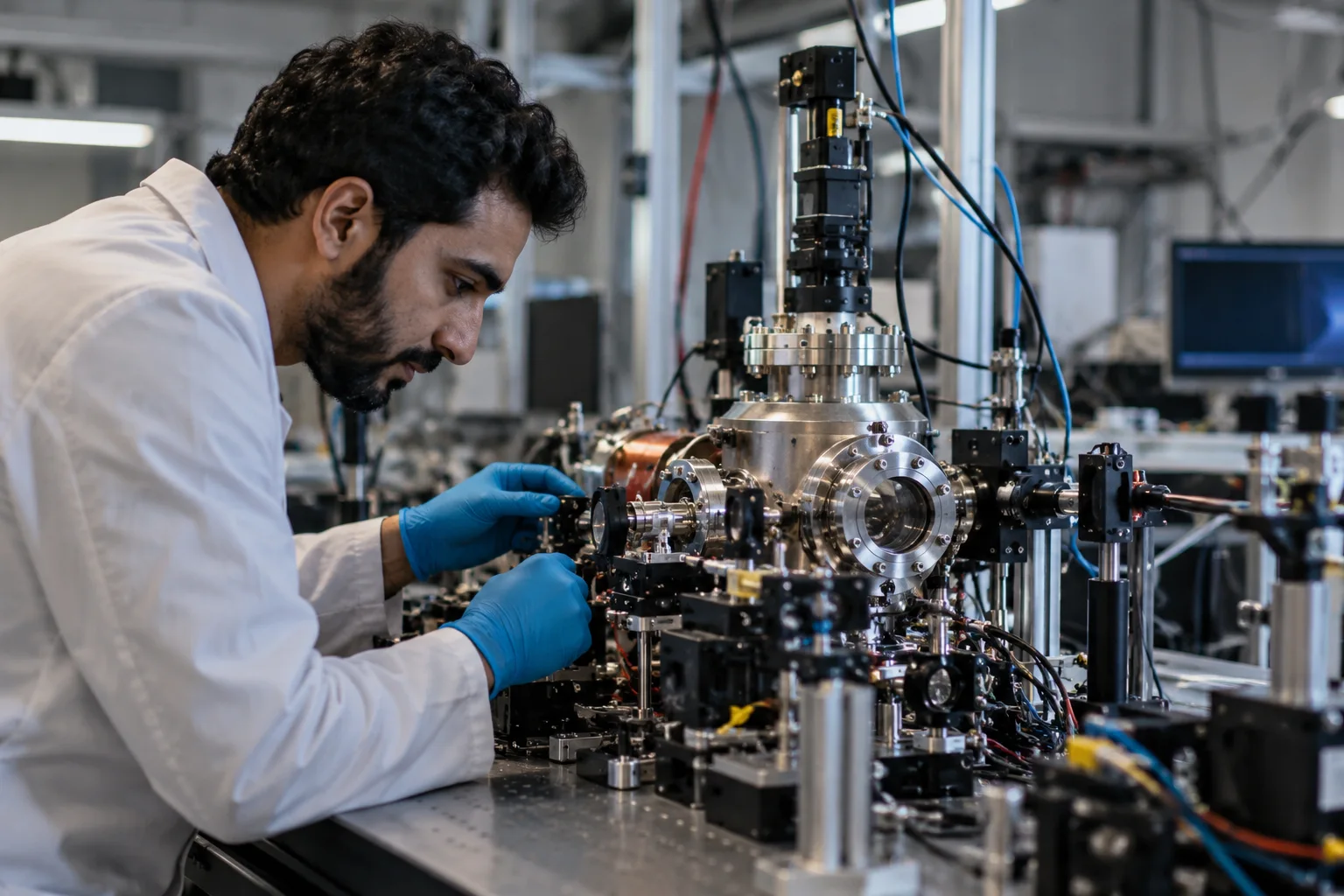
In plain language
Some of the most precise instruments measure quantum behaviour. A quantum sensor uses a single atom, a spin inside a crystal or a superconducting circuit as a very sensitive probe. Because these systems respond to very small changes in their surroundings, they can detect tiny magnetic fields, gravity or rotation, or keep time more accurately than older devices.
The main hope is positioning and timing that does not depend on satellite signals, which can be jammed or blocked. In May 2024, the UK government reported a flight test in which compact quantum components were carried on a test aircraft as a step in that direction. The technology is still at an early stage, and most quantum sensors work best in controlled conditions.
Technical explanation
Degen, Reinhard and Cappellaro (2017) define quantum sensing as the use of a quantum system, quantum property or quantum phenomenon to measure a physical quantity. Their review lists spin qubits, trapped ions and flux qubits as the most common platforms, and notes that early examples included superconducting quantum interference devices and atomic vapour magnetometers and clocks.
Optical atomic clocks are a well-established example. Ludlow and colleagues (arXiv preprint, 2014) review optical clocks based on single trapped ions and on many neutral atoms, covering the key technical ingredients, the measurement precision and systematic uncertainty of some of the best clocks at the time, and their applications. Atom interferometers are another example: Bongs and colleagues (2019) describe how these devices, which split and recombine matter waves, have been moving out of the laboratory to serve as precise sensors in metrology, geophysics, space and navigation, and they discuss the technical challenges of that transition.
In May 2024 the UK government reported that Infleqtion, working with BAE Systems and QinetiQ, flight-tested a compact optical atomic clock and an ultra-cold-atom system on a QinetiQ test aircraft, as a step toward navigation that does not depend on satellite signals. The government release does not give performance figures from the flight, so the result should be treated as a feasibility demonstration rather than a measured accuracy.
What the evidence says
Each statement is typed by the strength of its evidence and linked to the source that supports it.
Demonstrated Shown in a published experiment, test or shipping product.
Quantum sensing uses a quantum system, quantum property or quantum phenomenon to measure a physical quantity.
Sources: [1]The most common quantum sensing platforms, according to the 2017 review, are spin qubits, trapped ions and flux qubits.
Sources: [1]Ludlow and colleagues review optical atomic clocks based on single trapped ions and on many neutral atoms, and report the measurement precision and systematic uncertainty of some of the best clocks at the time.
Sources: [3]In May 2024 the UK government reported that Infleqtion, with BAE Systems and QinetiQ, flight-tested a compact optical atomic clock and an ultra-cold-atom system on a QinetiQ test aircraft.
Sources: [4]Reported, unverified Stated by a company or team but not independently confirmed.
Atom interferometers have been moving out of the laboratory to serve as precise quantum sensors in metrology, geophysics, space and navigation, and this transition raises technical challenges.
Sources: [2] · medium confidenceThe 2024 flight test was described as a step toward navigation that does not depend on satellite signals, and the government release does not report measured accuracy.
Sources: [4] · medium confidenceLimitations and open problems
- Many quantum sensors need very low temperatures, vacuum or careful shielding, which makes them harder to run outside a laboratory.
- The 2024 UK flight test was a feasibility demonstration; the government release does not report measured accuracy or sustained operation.
- Atom interferometers and clocks are large and power-hungry compared with conventional sensors, so miniaturisation is a central engineering challenge (Bongs and colleagues, 2019).
- Quantum sensors are sensitive to their environment, which can be an advantage for measurement but makes them harder to isolate from noise.
- Cost and supply of specialised components are barriers to wide adoption, and the sources reviewed here do not give verified cost figures.
Possible future uses
Ideas, not predictions. None of these has been demonstrated.
- Navigation for ships, aircraft and vehicles in areas where satellite signals are weak or blocked.
- Mapping underground structures, minerals or oil reserves from very small changes in gravity.
- Wearable or portable magnetic sensors for medical imaging of heart or brain activity.
Product concepts: GPS-free underground position reference
Timeline
- Jul 2014Ludlow and colleagues post a review of optical atomic clocks to arXiv. Sources: [3]
- Jul 2017Degen, Reinhard and Cappellaro's review 'Quantum sensing' is published in Reviews of Modern Physics. Sources: [1]
- 2019Bongs and colleagues publish a perspective in Nature Reviews Physics on atom-interferometric quantum sensors moving into real-world applications. Sources: [2]
- 13 May 2024The UK government reports a flight test of quantum navigation components on a QinetiQ test aircraft. Sources: [4]
Futures this could help bring about
Glossary
- Quantum sensing
- Using a quantum system, property or effect to measure a physical quantity more precisely than classical methods allow.
- Qubit
- The basic unit of quantum information, a two-level quantum system such as an atomic spin or a superconducting circuit.
- Atomic clock
- A timekeeping device that counts oscillations of light or microwaves emitted by atoms at a very stable frequency.
- Atom interferometry
- A technique that splits atoms into matter waves, recombines them and reads out the pattern to measure forces such as gravity or rotation.
Sources
- review article
Quantum sensing
C. L. Degen, F. Reinhard, P. Cappellaro. Reviews of Modern Physics, Jul 2017. DOI: 10.1103/RevModPhys.89.035002. Accessed 21 Oct 2026. - review article
Taking atom interferometric quantum sensors from the laboratory to real-world applications
Kai Bongs, Michael Holynski, Jamie Vovrosh et al.. Nature Reviews Physics, 2019. DOI: 10.1038/s42254-019-0117-4. Accessed 21 Oct 2026. - preprint
Optical Atomic Clocks
Andrew D. Ludlow, Martin M. Boyd, Jun Ye et al.. arXiv, Jul 2014. Accessed 21 Oct 2026. - government report
Un-jammable quantum tech takes flight to boost UK's resilience against hostile actors
Department for Science, Innovation and Technology, 13 May 2024. Accessed 21 Oct 2026.
Revision history
3 changes since this profile was created.