How far are we from humanoid robots in the home?
Companies are building humanoid robots for household work, and 1X has opened consumer pre-orders for its NEO home robot with first deliveries planned for 2026. Published evidence of reliable household tasks at scale is still missing. Grippers, artificial muscles and tactile skins each work in laboratory prototypes, but a 2025 review says tactile robotics has often stalled.
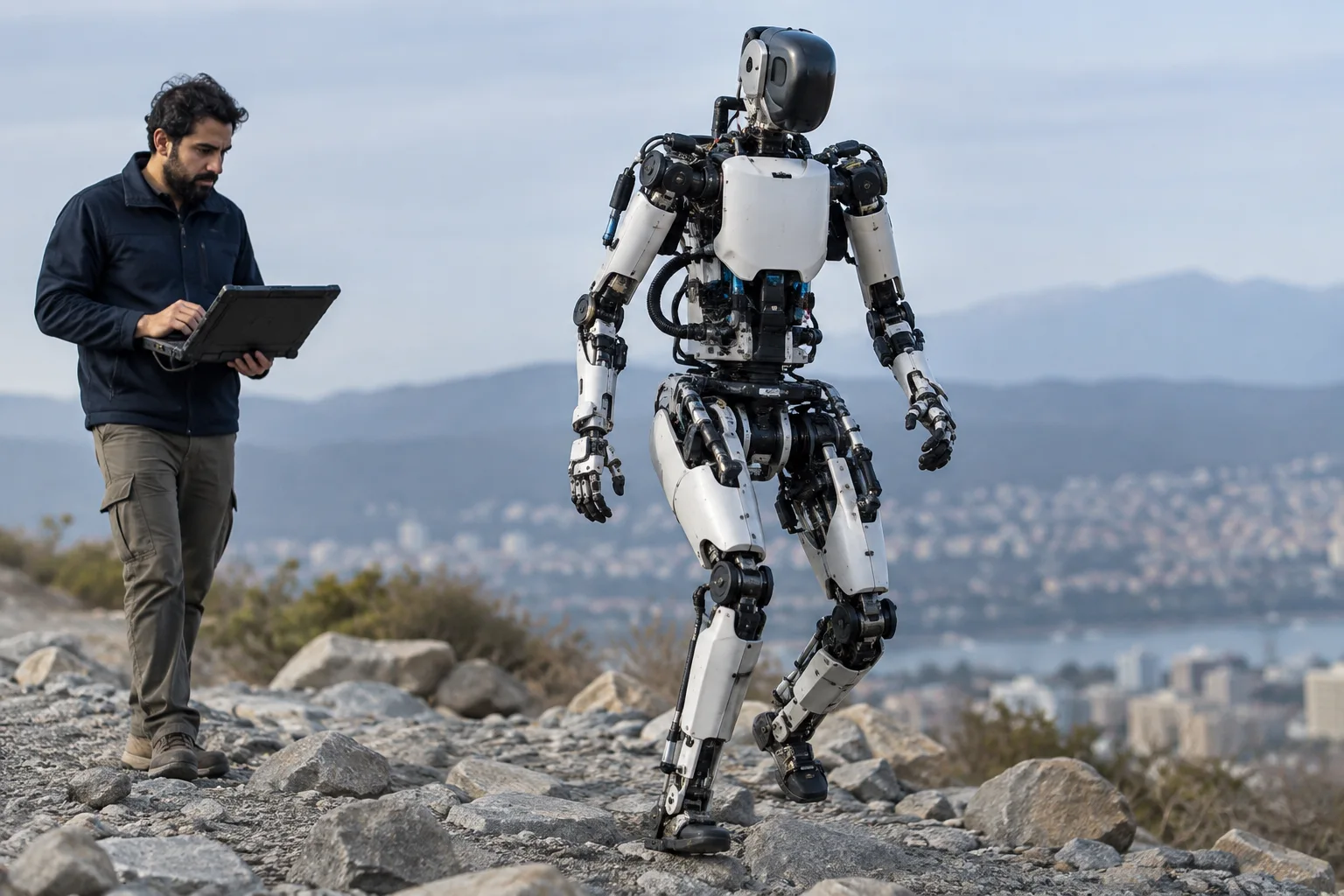
Getting closer. Prototypes exist, but not in real-world use.
Engineering prototypes exist and one company has taken consumer pre-orders, but no source reviewed reports independent household deployments with measured task success. Figure announced Figure 03 in October 2025 with safety-oriented design features such as foam at pinch points, and its announcement does not mention a home pilot or name a customer. 1X states that first NEO orders will ship to consumer homes in 2026, which is a planned delivery and not yet confirmed. Laboratory results for artificial muscles come from single legs and small actuators, not full humanoid bodies.
The tech tree
Everything recorded on Vrulum that this future needs, oldest foundations at the top and the goal at the bottom. Lines show what each step requires.
- 2001Self-healing polymersResearch and prototypes Being researched.
- 2017Robotic fruit and vegetable harvestingPilot and early commercial Unlocked.
- 2004Electronic skinResearch and prototypesRequires: Self-healing polymers. Being researched.
- 2014Artificial muscles (soft actuators)Research and prototypes Being researched.
- 2014Soft robotic grippersResearch and prototypesRequires: Robotic fruit and vegetable harvesting. Being researched.
- 2023Humanoid robotsResearch and prototypes Being researched.
- 2017Artificial muscle actuators work in the labDone Unlocked.
- 2024Muscle-driven robotic leg demonstratedDone Unlocked.
- 2025Soft robotic grippers developed and reviewedDone Unlocked.
- 2025Consumer pre-orders for a home robot openedDone Unlocked.
- Date not recordedTactile electronic skin for robot touchIn progress Being researched.
- Date not recordedHumanoid robot model announcedIn progress Being researched.
- Date not recordedHumanoid manufacturing scaled upIn progress Being researched.
- Date not recordedFirst consumer home deliveriesIn progress Being researched.
- Date not recordedReliable unsupervised household work at scaleNot started Locked.
- GoalHumanoid robots in the homeGoalRequires: Humanoid robots, Soft robotic grippers, Artificial muscles (soft actuators), Electronic skin, Artificial muscle actuators work in the lab, Muscle-driven robotic leg demonstrated, Soft robotic grippers developed and reviewed, Tactile electronic skin for robot touch, Humanoid robot model announced, Humanoid manufacturing scaled up, Consumer pre-orders for a home robot opened, First consumer home deliveries, Reliable unsupervised household work at scale. Locked.
The road so far
4 of 9 steps done, 4 in progress.
- Done · 27 Nov 2017Artificial muscle actuators work in the lab
Origami-inspired fluid-driven muscles contracted over 90% of their initial length in the best design and gave an actuation stress of about 600 kPa, in laboratory tests reported in PNAS in 2017. [4]
- Done · 9 Sept 2024Muscle-driven robotic leg demonstrated
An electrohydraulic musculoskeletal robotic leg reached a minimum net cost of transport of 0.73 at 225 g in a 2024 Nature Communications paper. In one comparison it drew 1.2% of the power of a DC-motor leg, and it held a squat on 9.4 mW against 17 W for the DC-motor leg. [3]
- Done · 27 Oct 2025Soft robotic grippers developed and reviewed
A 2025 review surveys soft gripper designs using fluid, mechanical, electric, magnetic and thermal actuation, and covers gripper materials and performance. [5]
- In progressTactile electronic skin for robot touch
A 2025 arXiv preprint from Nathan Lepora says progress in tactile robotics has often stalled and lists human-like dexterity among future applications rather than completed ones. [6]
- In progressHumanoid robot model announced
Figure announced Figure 03 in October 2025 with soft textiles, foam at pinch points and wireless charging. The announcement does not mention a home pilot or name customers. [1]
- In progressHumanoid manufacturing scaled up
Figure states its first-generation BotQ line is initially capable of up to 12,000 robots a year, with a goal of 100,000 over four years. These are company targets, not delivered output. [1]
- Done · 28 Oct 2025Consumer pre-orders for a home robot opened
1X's NEO home robot went on pre-order from 28 October 2025, with an Early Access price of $20,000 and a $499 per month subscription option. [2]
- In progressFirst consumer home deliveries
1X says first orders will ship to consumer homes in 2026, primarily in the US. For any chore NEO does not yet know, owners can schedule a 1X expert to guide it through the task. [2]
- Not startedReliable unsupervised household work at scale
No source reviewed shows independent measurements of household task success across many homes. Scale would need published field data and a service model.
Why it matters
A household robot could help older people and people with disabilities with everyday tasks such as laundry and tidying. The gap between a demonstration video and a machine that works unsupervised in many different homes is large, and it is mainly about dexterity, touch sensing, safety around people and cost. Claims in this area are mostly from companies, so independent trial results will matter more than launch announcements.
What stands in the way
- Dexterity and touch sensing have not matured; a 2025 review says tactile robotics has often stalled.
- Autonomy on unfamiliar tasks is limited; 1X says owners may need an expert to guide NEO through tasks it does not yet know.
- Cost: the Early Access price is $20,000, or $499 per month on subscription.
- Artificial-muscle results so far come from lab-scale legs and actuators, not full humanoid bodies.
- Safety around people in homes has no independent test in the sources reviewed; Figure 03 uses soft textiles and foam at pinch points, but no independent safety test is cited.
Published forecasts
What others have predicted. These are their estimates, not ours.
| Who | Forecast | Timeframe | Made |
|---|---|---|---|
| 1X Technologies | Start delivering NEO primarily in the US in 2026, with expansion to other markets from 2027. [2] | 2026–2027 | 28 Oct 2025 |
Signals to watch
- Independent published trials that report task success rates across several real homes.
- 1X confirms delivery counts for NEO to US customers.
- A humanoid maker names paying home customers with a published service model.
- Tactile skins reach production robots with published durability data.
- Artificial-muscle limbs are shown at full humanoid scale with published lifetime and force data.
Sources
- company announcement
Introducing Figure 03
Figure AI, 9 Oct 2025. - company announcement
1X NEO Home Robot | Order Today
1X Technologies, 28 Oct 2025. - peer reviewed paper
Electrohydraulic musculoskeletal robotic leg for agile, adaptive, yet energy-efficient locomotion
Thomas J. K. Buchner, Toshihiko Fukushima, Amirhossein Kazemipour et al.. Nature Communications, 9 Sept 2024. - peer reviewed paper
Fluid-driven origami-inspired artificial muscles
Shuguang Li, Daniel M. Vogt, Daniela Rus et al.. Proceedings of the National Academy of Sciences, 27 Nov 2017. - review article
Soft robotic grippers: a review
Youyou Zhang, Jianhao Man, Xiaoang Liu et al.. Frontiers in Materials, 27 Oct 2025. - preprint
Tactile Robotics: Past and Future
Nathan F. Lepora. arXiv, 30 Nov 2025.
Last reviewed 21 Oct 2026.