Photonic quantum computers
Also known as Photonic quantum computing, Optical quantum computers, Light-based quantum computers
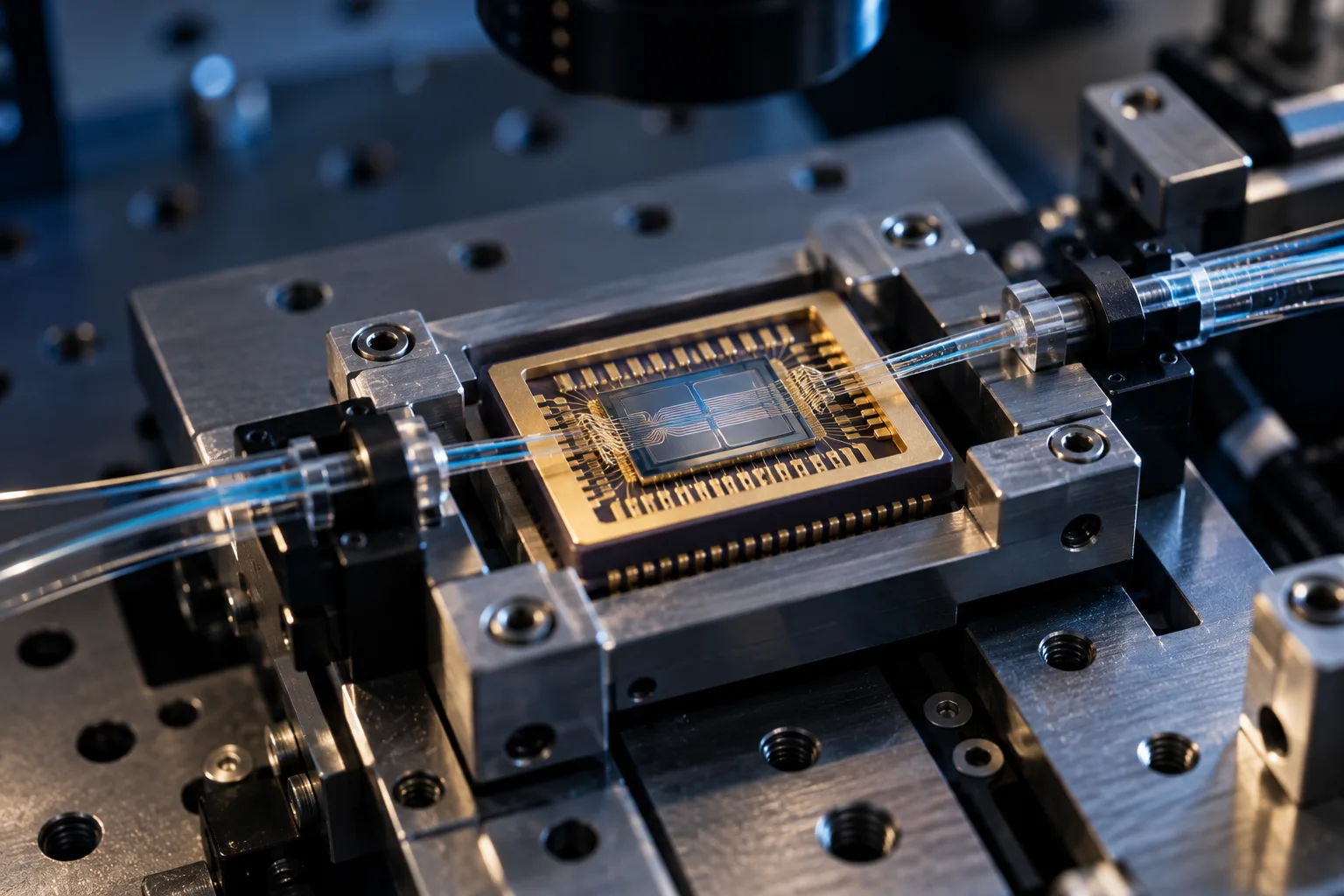
Photonic quantum computers use single particles of light, photons, as qubits and move them through chips and optical fibre. Companies such as Xanadu, PsiQuantum and Quandela have reported working prototypes and chip-level component results, but photon loss is a major barrier to building error-corrected machines at useful scale.
In plain language
Most quantum computers store information in atoms, ions or tiny superconducting circuits that must be kept very cold or very still. A photonic quantum computer instead uses photons, the particles that make up light. Each photon can carry a quantum bit of information in a property such as its polarisation or its time of arrival. Because photons move quickly and barely interact with their surroundings, they can be sent along optical fibre and across chips, and many designs run at or near room temperature in their optical parts.
The main difficulty is that photons are easy to lose. If a photon is absorbed, scattered or fails to reach a detector, the information it carried is gone. Photonic designs therefore have to be robust to missing photons, which is a different problem from the one faced by machines that store qubits in matter. Recent company announcements show progress on chips, interconnects and error-correction building blocks, and researchers have started to estimate how much photon loss a design can tolerate before errors become unmanageable.
Technical explanation
In photonic architectures, qubits are encoded in optical modes or in the properties of single photons, and computation is performed with optical components such as phase shifters, interferometers and photon detectors. Many recent schemes build larger entangled states from smaller resource states using fusion operations, which succeed only some of the time, so the designs must plan for failures. The loss-per-photon preprint compares encoded and adaptive schemes with boosted fusion networks that use neither.
Photon loss is the dominant error source in photon-mediated computing, according to Dessertaine and colleagues in their 2024 preprint on the honeycomb Floquet code. That preprint reports a photon loss threshold of 6.3 per cent for the honeycomb Floquet code on a tailored spin-optical architecture, compared with an approach based on the surface code, under the noise model used in that work. A separate PsiQuantum-linked preprint (arXiv 2506.11975, reported by The Quantum Insider in June 2025) uses a loss-per-photon threshold metric and reports that boosted fusion networks without encoding or adaptivity fall below 1 per cent, while some encoded and adaptive schemes reach about 18.8 per cent for a 224-qubit resource state. Both are preprints and their figures depend on the noise model and resource-state size chosen.
On the hardware side, PsiQuantum reports component fidelities for its Omega chipset, including 99.98 per cent single-qubit state preparation and measurement fidelity, 99.5 per cent two-photon interference visibility and 99.72 per cent chip-to-chip interconnect fidelity. Xanadu reports its 12-qubit Aurora system, built from four networked server racks with 35 photonic chips and about 13 km of fibre, and it states that the work quantified optical loss tolerances without giving a loss figure in its release. These are company-reported results, and test conditions for each figure are not given in the sources reviewed.
What the evidence says
Each statement is typed by the strength of its evidence and linked to the source that supports it.
Reported, unverified Stated by a company or team but not independently confirmed.
Xanadu's Aurora is a 12-qubit photonic quantum computer built from four modular server racks, with 35 photonic chips and about 13 km of optical fibre, operating at room temperature.
Sources: [1] · Release body, hardware figures · medium confidenceXanadu says its Aurora results were published in Nature and quantified optical loss tolerances, but its release gives no loss figure and names optical loss as the next major obstacle to fault tolerance.
Sources: [1] · Release, optical loss paragraph · medium confidencePsiQuantum reports Omega chipset results of 99.98 per cent single-qubit state preparation and measurement fidelity, 99.5 per cent two-photon interference visibility and 99.72 per cent chip-to-chip interconnect fidelity, without detailed test conditions for each figure.
Sources: [2] · Performance figures section · medium confidencePsiQuantum's Omega chips are manufactured with GlobalFoundries, and the company uses barium titanate for low-loss optical switching and a superconducting material for single-photon detection.
Sources: [2] · Omega description · medium confidenceAccording to a 2024 preprint, photon loss is the primary error source in photon-mediated quantum computing.
Sources: [3] · Abstract · medium confidenceOn a tailored spin-optical architecture, the honeycomb Floquet code reaches a photon loss threshold of 6.3 per cent under consistent noise models, nearly double the surface code threshold on the previous architecture, according to a preprint that has not been peer reviewed.
Sources: [3] · Abstract · medium confidenceA PsiQuantum-linked preprint (arXiv 2506.11975) reports loss-per-photon thresholds from below 1 per cent for boosted fusion networks without encoding or adaptivity, to 18.8 per cent for a 224-qubit loopy diamond network with a {7,4} encoding.
Sources: [4] · Table of schemes · medium confidenceQuandela announced Belenos, a 12-qubit photonic quantum computer accessible through the cloud to commercial partners and researchers.
Sources: [5] · Launch summary · medium confidenceLimitations and open problems
- Photon loss is the main barrier to fault tolerance. Xanadu's release names optical loss as the next major obstacle and gives no numerical loss figure.
- Loss thresholds from the honeycomb Floquet code preprint (Dessertaine and colleagues, 2024) and the PsiQuantum-linked preprint (arXiv 2506.11975) depend on the chosen noise model and resource-state size, and neither is peer reviewed in the sources reviewed.
- PsiQuantum's Omega fidelities were reported without detailed test conditions for each figure, and the company says a new cooling system was used for many of the performance results.
- The largest photonic machine described in the sources reviewed has 12 qubits, so no machine at useful scale is demonstrated in these sources.
- Cost of the chips, cryogenic or cooling systems and networking hardware was not stated in the sources reviewed, so the economics of photonic machines cannot yet be assessed.
Possible future uses
Ideas, not predictions. None of these has been demonstrated.
- Networked photonic modules that share a common optical fabric, allowing a data centre to add quantum capacity in the same way it adds server racks.
- Photonic quantum processors placed beside supercomputers for hybrid workloads.
- Room-temperature quantum optical sensors and communications components built from the same chip processes used for quantum computing.
Timeline
- 9 Oct 2024Dessertaine and colleagues submit a preprint comparing the honeycomb Floquet code and the surface code on a photonic architecture, reporting a 6.3 per cent photon loss threshold for the honeycomb code. Sources: [3]
- 22 Jan 2025Xanadu announces Aurora, a 12-qubit photonic system built from four networked server racks, and says the results are published in Nature. Sources: [1]
- 26 Feb 2025PsiQuantum announces the Omega chipset, made with GlobalFoundries, and reports 99.98 per cent single-qubit state preparation and measurement fidelity and 99.72 per cent chip-to-chip interconnect fidelity. Sources: [2]
- 22 May 2025Quandela announces Belenos, a 12-qubit photonic quantum computer available through the cloud. Sources: [5]
- 17 Jun 2025Coverage of a PsiQuantum-linked preprint (arXiv 2506.11975) reports loss-per-photon thresholds for several fusion-network schemes, from below 1 per cent to about 18.8 per cent. Sources: [4]
Futures this could help bring about
Related breakthroughs
Glossary
- Photonic qubit
- A quantum bit encoded in a property of a single photon, such as its polarisation or the time at which it arrives.
- Fusion measurement
- A measurement that joins two small entangled photon states into a larger one. It succeeds only some of the time, so schemes must plan for failures.
- Photon loss
- A photon being absorbed, scattered or otherwise failing to reach a detector, which erases the information it carried.
- Loss-per-photon threshold
- The highest fraction of photons that can be lost before errors in a scheme accumulate beyond control, as used in the PsiQuantum-linked preprint.
Sources
- company announcement
Xanadu introduces Aurora: world's first scalable, networked and modular quantum computer
Xanadu (via Newswire.ca), 22 Jan 2025. Accessed 21 Oct 2026. - company announcement
PsiQuantum Announces Omega, a Manufacturable Chipset for Photonic Quantum Computing
PsiQuantum, 26 Feb 2025. Accessed 21 Oct 2026. - preprint
Enhanced Fault-tolerance in Photonic Quantum Computing: Comparing the Honeycomb Floquet Code and the Surface Code in Tailored Architecture
Théo Dessertaine, Boris Bourdoncle, Aurélie Denys et al.. arXiv, 9 Oct 2024. Accessed 21 Oct 2026. - news
PsiQuantum Study Maps Path to Loss-Tolerant Photonic Quantum Computing
The Quantum Insider, 17 Jun 2025. Accessed 21 Oct 2026. - news
Quandela to launch Belenos, accelerating its 2030 roadmap toward scalable photonic quantum systems
The Quantum Insider, 22 May 2025. Accessed 21 Oct 2026.
Revision history
3 changes since this profile was created.
What it took to get here
The inventions this technology was built on, oldest foundations at the top. Lines show what each one required.
- 2024Photonic quantum computersResearch and prototypesRequires: Quantum error correction. Being researched.