Topological qubits
Also known as Majorana qubits, Majorana-based qubits, Topological quantum computing
Topological qubits aim to store quantum information in Majorana zero modes, which could make the stored information less sensitive to local noise. Microsoft's 2025 Majorana 1 announcement and parity-readout paper are contested, and the existence of a working topological qubit is not yet established.
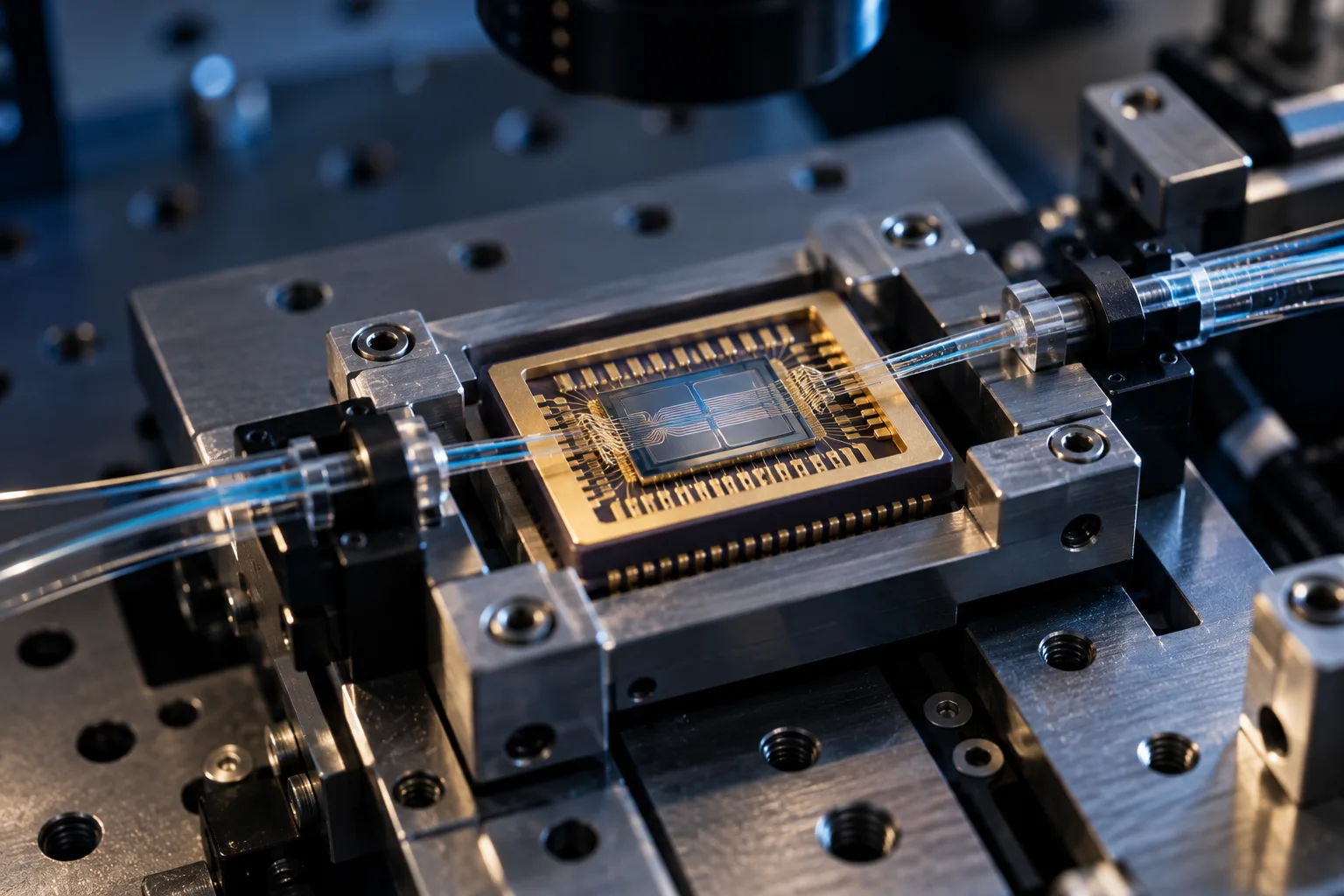
In plain language
A topological qubit would store information in a special state of matter rather than in an ordinary, fragile quantum state. The idea is that a pair of Majorana zero modes, exotic states that can sit at the two ends of a superconducting wire, together hold one bit of quantum information in their shared parity (whether the pair holds an even or an odd number of electrons). Because the information is spread across two distant points, a local disturbance would be less likely to flip it. That is the idea behind Microsoft's research programme.
The science is contested. In February 2025 Microsoft announced its Majorana 1 chip and published a Nature paper on reading out this parity. Critics say the data do not yet show that the wires host Majorana modes, and the field has a history of claims that were later retracted. Until independent groups reproduce the core measurements, this profile treats topological qubits as an unproven idea with a disputed experimental record.
Technical explanation
Majorana zero modes are predicted to appear at the ends of a semiconductor nanowire under a magnetic field. The nanowires in Microsoft's devices combine indium arsenide with an aluminium superconducting shell. Microsoft's proposed qubit, which it calls a tetron, encodes information in the fermion parity of two such modes. In the 2024 preprint by Aghaee and colleagues, parity is read out by tunnel-coupling the nanowire to quantum dots and detecting a shift of up to about 1 fF in their quantum capacitance, a method the authors describe as interferometric single-shot readout.
The reported figures are a signal-to-noise ratio of 1 in about 3.7 microseconds at optimal flux values, dwell times longer than 1 ms in the two associated parity states at an in-plane field of about 2 T, and a parity measurement error probability of about 1%. These numbers depend on the device being in a topological regime, and that depends on a gap determination. Legg (2025) argues that the topological gap protocol used for that determination can classify the same regions as gapped or gapless depending on parameters, and that the conductance data in the regions used for parity readout show no clear gap. Single-shot parity readout is therefore not the same thing as a demonstrated topological qubit that supports gate operations, braiding or error detection.
Microsoft's stated roadmap runs from a 4 x 2 tetron array, in which a two-qubit subset would show entanglement and measurement-based braiding, to an eight-qubit array running error detection on two logical qubits, and later a 27 x 13 array for error correction. The company says its custom codes reduce overhead roughly tenfold compared with the previous state-of-the-art approach. These steps and the overhead figure are company statements, and the sources reviewed do not show the later steps as completed.
What the evidence says
Each statement is typed by the strength of its evidence and linked to the source that supports it.
Demonstrated Shown in a published experiment, test or shipping product.
Nature retracted the 2018 letter 'Quantized Majorana conductance' in 2021 because the authors could no longer claim observation of a quantized Majorana conductance; after recalibration the plateau values shifted by about 8%, and some points fell outside the 2-sigma error bars when the data were replotted.
Sources: [5], [6] · Stated reasonReported, unverified Stated by a company or team but not independently confirmed.
Microsoft reports single-shot interferometric readout of fermion parity in InAs-Al nanowire devices, with a signal-to-noise ratio of 1 in about 3.7 microseconds at optimal flux and a parity measurement error probability of about 1%.
Sources: [2], [3] · Abstract (arXiv preprint) · medium confidenceMicrosoft says Majorana 1 places eight topological qubits on a chip designed to hold one million.
Sources: [1] · Announcement text · medium confidenceProposed A design or plan that has not yet been built or tested.
Microsoft plans entanglement, measurement-based braiding and error detection on its eight-qubit array as later steps, and does not present them as completed results.
Sources: [1] · Scaling planDisputed Contested by other credible sources.
The authors state that the measured parity is consistent with a pair of Majorana zero modes about 3 micrometres apart.
Sources: [3], [4] · Abstract (arXiv preprint); main argument (Legg) · low confidenceLegg argues that the gap determination relies on the topological gap protocol, which can classify the same regions as gapped or gapless depending on parameters, and that the conductance data in the regions used for parity readout show no clear gap.
Sources: [4] · Main argument · medium confidenceNature news, republished by Scientific American, reports that the paper's measurements do not by themselves show that the nanowire hosts two Majorana quasiparticles. Of the physicists quoted, one is cautious but positive, one is sceptical of the approach, one criticises the early announcement, and one says too little data has been shared to comment.
Sources: [7] · Critics' views · medium confidenceSergey Frolov and Vincent Mourik identified inconsistencies between the raw data they were given and the published figures of the 2018 letter; Frolov and Mourik dispute the account of events in the retraction notice.
Sources: [6] · Concerns raised by other scientists · medium confidenceLimitations and open problems
- The existence of topological modes in the Microsoft devices is disputed. Legg (2025) challenges the central parity-readout claim, and the sources reviewed did not include a published reply from Microsoft.
- The field has a retraction history. A 2018 Nature letter claiming quantized Majorana conductance was retracted in 2021 after data problems were found, so claims in this area need independent replication.
- Microsoft describes entanglement, measurement-based braiding and error detection on its eight-qubit array as planned next steps, not completed results.
- The sources reviewed do not report gate fidelities, coherence times or qubit-to-qubit operation data for topological qubits, so a qubit-level performance comparison with other quantum platforms is not possible from them.
- The claim of a chip designed to hold one million topological qubits is a company design target, not a measured result.
Possible future uses
Ideas, not predictions. None of these has been demonstrated.
- If topological qubits can be made reliable, they could reduce the number of physical qubits needed for error correction, which Microsoft estimates at roughly tenfold less overhead than the previous state-of-the-art approach (a company estimate).
- A fault-tolerant prototype built from topological qubits under the DARPA US2QC programme, which Microsoft says it intends to build in years rather than decades. This is a plan, not a result.
- Modular chip designs built from tetron arrays, scaled to very large qubit counts.
Timeline
- 28 Mar 2018Nature publishes 'Quantized Majorana conductance' by a TU Delft-affiliated team, which claimed evidence for Majorana zero modes. Sources: [5], [6]
- 8 Mar 2021Nature retracts the 2018 letter after the authors could no longer claim observation of a quantized Majorana conductance. Sources: [5], [6]
- 17 Jan 2024Preprint 'Interferometric Single-Shot Parity Measurement in an InAs-Al Hybrid Device' posted to arXiv by Microsoft Quantum. Sources: [3]
- 19 Feb 2025Microsoft announces Majorana 1 as a quantum processor with a topological core, citing a Nature paper and Station Q data. Sources: [1]
- 19 Feb 2025Nature publishes the parity-readout paper (volume 638, pages 651-655), on the same day as Microsoft's announcement. Sources: [2], [4], [1]
- 11 Mar 2025Henry Legg posts a comment on arXiv arguing that the parity-readout paper's gap determination is unreliable. Sources: [4]
Glossary
- Majorana zero mode
- A predicted state that sits at the end of a special superconducting wire and behaves as its own antiparticle. Its existence in real devices is disputed.
- Fermion parity
- Whether a group of electrons holds an even or odd number of particles. Topological qubit designs store information in this property.
- Topological gap protocol
- A test used to decide whether a nanowire has a superconducting gap consistent with topological superconductivity. Critics say it can give different answers under different conditions.
- Quantum capacitance
- A measure of how a quantum system stores charge. Changes in it can be used to read out the state of a nearby device.
Sources
- company announcement
Microsoft unveils Majorana 1, the world's first quantum processor powered by topological qubits
Chetan Nayak. Microsoft Azure Quantum Blog, 19 Feb 2025. Accessed 22 Oct 2026. - peer reviewed paper
Interferometric single-shot parity measurement in InAs-Al hybrid devices
Microsoft Quantum. Nature, 19 Feb 2025. DOI: 10.1038/s41586-024-08445-2. Accessed 22 Oct 2026. - preprint
Interferometric Single-Shot Parity Measurement in an InAs-Al Hybrid Device
Morteza Aghaee, Alejandro Alcaraz Ramirez. arXiv, 17 Jan 2024. Accessed 22 Oct 2026. - preprint
Comment on 'Interferometric single-shot parity measurement in InAs-Al hybrid devices', Microsoft Quantum, Nature 638, 651-655 (2025)
Henry F. Legg. arXiv, 11 Mar 2025. Accessed 22 Oct 2026. - other
Retraction Note: Quantized Majorana conductance (Nature, (2018), 556, 7699, (74-79), 10.1038/nature26142)
Nature, Mar 2021. DOI: 10.1038/s41586-021-03373-x. Accessed 22 Oct 2026. - news
Authors retract Nature Majorana paper, apologize for 'insufficient scientific rigour'
Ivan Oransky. Retraction Watch, 8 Mar 2021. Accessed 22 Oct 2026. - news
Microsoft Claims Quantum-Computing Breakthrough, but Some Physicists Are Skeptical
Davide Castelvecchi. Scientific American, 19 Feb 2025. Accessed 22 Oct 2026.
Revision history
3 changes since this profile was created.