Silicon spin qubits
Also known as Spin qubits in silicon, Silicon quantum dot qubits, Si spin qubits
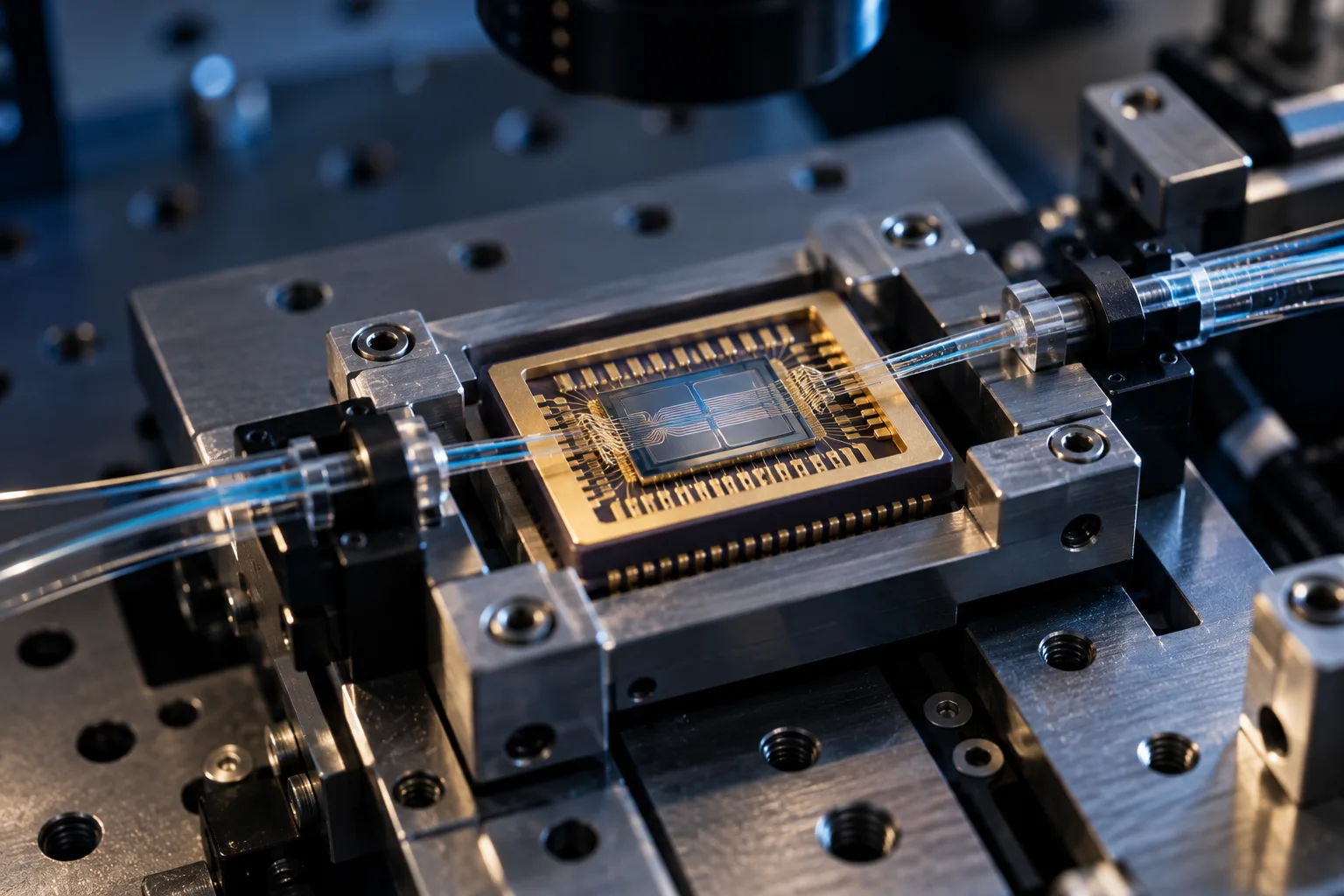
Silicon spin qubits store quantum information in the spin of a single electron held in a tiny silicon structure. Recent results show two-qubit devices made in a 300 mm semiconductor foundry reaching gate fidelities above 99%, but these are small arrays and the field has not yet shown error-corrected logical qubits.
In plain language
A silicon spin qubit uses the spin of a single electron as its unit of quantum information. The electron is trapped in a tiny pocket inside a silicon chip, called a quantum dot, and its spin can point in two directions that stand for 0 and 1. Electric pulses move and control the electron, so the chip can be operated with the same kinds of gates and wiring used in ordinary electronics.
The appeal is manufacturing. Silicon is the material behind the computer chip industry, so a qubit built in silicon could in principle be made on the same production lines as conventional transistors. The main difficulty is that the spin is easily disturbed by its surroundings, so the best results so far need very clean silicon and very careful control. Most published demonstrations so far involve two qubits or small arrays.
Technical explanation
Silicon spin qubits are typically defined in silicon structures, where gate electrodes form quantum dots that each hold one electron. The qubit state is the electron spin. The 2020 work drove the qubit with electrically driven spin resonance and initialised and read the qubits through electron tunnelling (Yang and colleagues, 2020). Silicon can be isotopically enriched to remove atoms with nuclear spin, and the 2020 device used silicon-28 for this reason. The 2025 authors attribute a substantial share of operational errors to residual nuclear-spin-carrying isotopes (Steinacker and colleagues, 2025).
A 2020 Nature paper reported a two-qubit silicon unit cell operating at about 1.5 kelvin, with single-qubit gate fidelity of 98.6 per cent (Yang and colleagues, 2020). A 2022 Nature paper reported a silicon processor with single- and two-qubit gate fidelities all above 99.5 per cent by gate set tomography, and used it for a variational quantum eigensolver calculation (Xue and colleagues, 2022). In 2025, a Nature paper reported two-qubit silicon devices made with standard semiconductor tooling in a 300 mm foundry environment. Single- and two-qubit control fidelities exceeded 99 per cent for all four devices, state preparation and measurement fidelities reached up to 99.9 per cent, and coherence reached T1 = 9.5 s, T2* = 40.6 microseconds and T2 Hahn echo = 1.9 ms (Steinacker and colleagues, 2025).
Foundry work has also been led by industry. Intel announced its 12-qubit Tunnel Falls chip in June 2023, made on 300 mm wafers with qubits about 50 nanometres on each side, for research use. Public qubit counts remain small. None of the cited sources reports a logical qubit built from silicon spins.
What the evidence says
Each statement is typed by the strength of its evidence and linked to the source that supports it.
Demonstrated Shown in a published experiment, test or shipping product.
In a 300 mm foundry environment, single- and two-qubit control fidelities exceed 99% for all four silicon two-qubit devices studied.
Sources: [1] · AbstractState preparation and measurement fidelities reach up to 99.9% for the foundry-made silicon devices.
Sources: [1] · AbstractThe foundry-made silicon devices reach spin lifetime T1 of 9.5 seconds, T2* of 40.6 microseconds and Hahn-echo coherence T2 of 1.9 milliseconds in the published version.
Sources: [1] · AbstractResidual nuclear spin-carrying isotopes contribute substantially to operational errors in the foundry-made silicon devices.
Sources: [1] · Abstract · medium confidenceA silicon two-qubit unit cell operated at about 1.5 kelvin reached single-qubit gate fidelity of 98.6%, using electron tunnelling for initialisation and readout.
Sources: [4] · AbstractA silicon spin processor reported single- and two-qubit gate fidelities all above 99.5%, extracted by gate set tomography, and kept single-qubit fidelities above 99% when crosstalk and idling errors were included.
Sources: [3] · AbstractIntel's Tunnel Falls is a 12-qubit silicon spin chip made on 300 mm wafers, with qubits about 50 nanometres by 50 nanometres, released to research partners.
Sources: [5] · Announcement body · medium confidenceProposed A design or plan that has not yet been built or tested.
The authors identify further isotopic purification as a route to higher performance for foundry-made silicon spin qubits.
Sources: [1] · Abstract · medium confidenceDilution refrigerators have limited cooling power, and the authors suggest that spin-based quantum computers could run in a pumped helium-4 system, which offers much greater cooling power, after operating a silicon unit cell at about 1.5 kelvin.
Sources: [4] · Abstract · medium confidenceLimitations and open problems
- Demonstrated results are for two-qubit devices and small arrays. The 2025 Nature paper reports two-qubit devices across four units, and Intel's Tunnel Falls is a 12-qubit research chip; neither shows the qubit counts a fault-tolerant machine would need.
- Residual nuclear-spin-carrying isotopes contribute substantially to operational errors in foundry-made devices, and the authors identify further isotopic purification as a route to higher performance (Steinacker and colleagues, 2025).
- The sources reviewed here do not state the operating temperature of the 2025 foundry devices in their abstracts. The hot-qubit work at about 1.5 kelvin (Yang and colleagues, 2020) reached 98.6 per cent single-qubit fidelity, and the sources reviewed here do not report a foundry-made silicon device operating above 1 kelvin at the same fidelity.
- Reported coherence values differ between versions of the same foundry study. The 2024 preprint gave T1 = 6.3 s and T2 Hahn echo = 803 microseconds, while the published abstract gives T1 = 9.5 s and T2 Hahn echo = 1.9 ms, so figures should be quoted with their version.
- High gate fidelity does not by itself show error correction. Xue and colleagues (2022) reported gate fidelities approaching the roughly 1 per cent surface code threshold, but the sources reviewed here do not report an error-corrected logical qubit built from silicon spins.
- The foundry results use a small number of devices. Wider yield and uniformity across large arrays, and the cost of isotopically enriched silicon, were not quantified in the sources reviewed here.
Possible future uses
Ideas, not predictions. None of these has been demonstrated.
- Qubit arrays fabricated on existing 300 mm CMOS lines, sharing a chip with the classical control electronics needed to run them.
- Silicon quantum processors that run at temperatures warm enough to reduce the cooling load on dilution refrigerators.
- Spin-based quantum sensors built on the same silicon process platform as the qubit devices.
Timeline
- 15 Apr 2020Two-qubit silicon unit cell operated at about 1.5 kelvin with 98.6 per cent single-qubit gate fidelity, published in Nature. Sources: [4]
- 19 Jan 2022Silicon spin processor reported with single- and two-qubit gate fidelities above 99.5 per cent by gate set tomography, published in Nature. Sources: [3]
- 15 Jun 2023Intel announces Tunnel Falls, a 12-qubit silicon spin chip made on 300 mm wafers, for research use. Sources: [5]
- 21 Oct 2024Preprint reports 300 mm foundry-made silicon spin devices with control fidelities above 99 per cent. Sources: [2]
- 24 Sept 2025Nature publishes foundry-made silicon two-qubit devices with control fidelities above 99 per cent for all four devices and state preparation and measurement fidelity up to 99.9 per cent. Sources: [1]
Futures this could help bring about
Glossary
- Quantum dot
- A tiny region in a semiconductor where electrons are trapped so that their number and energy can be controlled.
- Spin qubit
- A quantum bit whose 0 and 1 states are the two possible spin directions of a single electron or nucleus.
- Gate set tomography
- A method that characterises the actual quantum gates a device performs, used to estimate gate fidelity and state preparation and measurement errors.
- Isotopic purification
- Removing atoms with nuclear spin, such as silicon-29, from a material so that the remaining atoms cause less magnetic noise.
Sources
- peer reviewed paper
Industry-compatible silicon spin-qubit unit cells exceeding 99% fidelity
Paul Steinacker, Nard Dumoulin Stuyck, Wee Han Lim et al.. Nature, 24 Sept 2025. DOI: 10.1038/s41586-025-09531-9. Accessed 21 Oct 2026. - preprint
A 300 mm foundry silicon spin qubit unit cell exceeding 99% fidelity in all operations
Paul Steinacker, Nard Dumoulin Stuyck, Wee Han Lim et al.. arXiv, 21 Oct 2024. Accessed 21 Oct 2026. - peer reviewed paper
Quantum logic with spin qubits crossing the surface code threshold
X. Xue, M. Russ, N. Samkharadze et al.. Nature, 19 Jan 2022. DOI: 10.1038/s41586-021-04273-w. Accessed 21 Oct 2026. - peer reviewed paper
Operation of a silicon quantum processor unit cell above one kelvin
C. H. Yang, R. C. C. Leon, J. C. C. Hwang et al.. Nature, 15 Apr 2020. DOI: 10.1038/s41586-020-2171-6. Accessed 21 Oct 2026. - company announcement
Intel's New Chip to Advance Silicon Spin Qubit Research for Quantum Computing
Intel Corporation, 15 Jun 2023. Accessed 21 Oct 2026.
Revision history
3 changes since this profile was created.