Neutral-atom quantum computers
Also known as Neutral-atom quantum computing, Atom-array quantum computers, Optical-tweezer quantum computers
Neutral-atom quantum computers hold individual atoms in optical tweezers and use their internal states as qubits, with laser-driven links between neighbouring atoms. Since 2023, research groups have reported high-fidelity two-qubit gates, small logical-qubit processors and arrays of thousands of atoms, but no neutral-atom machine has yet run a large, error-corrected calculation.
In plain language
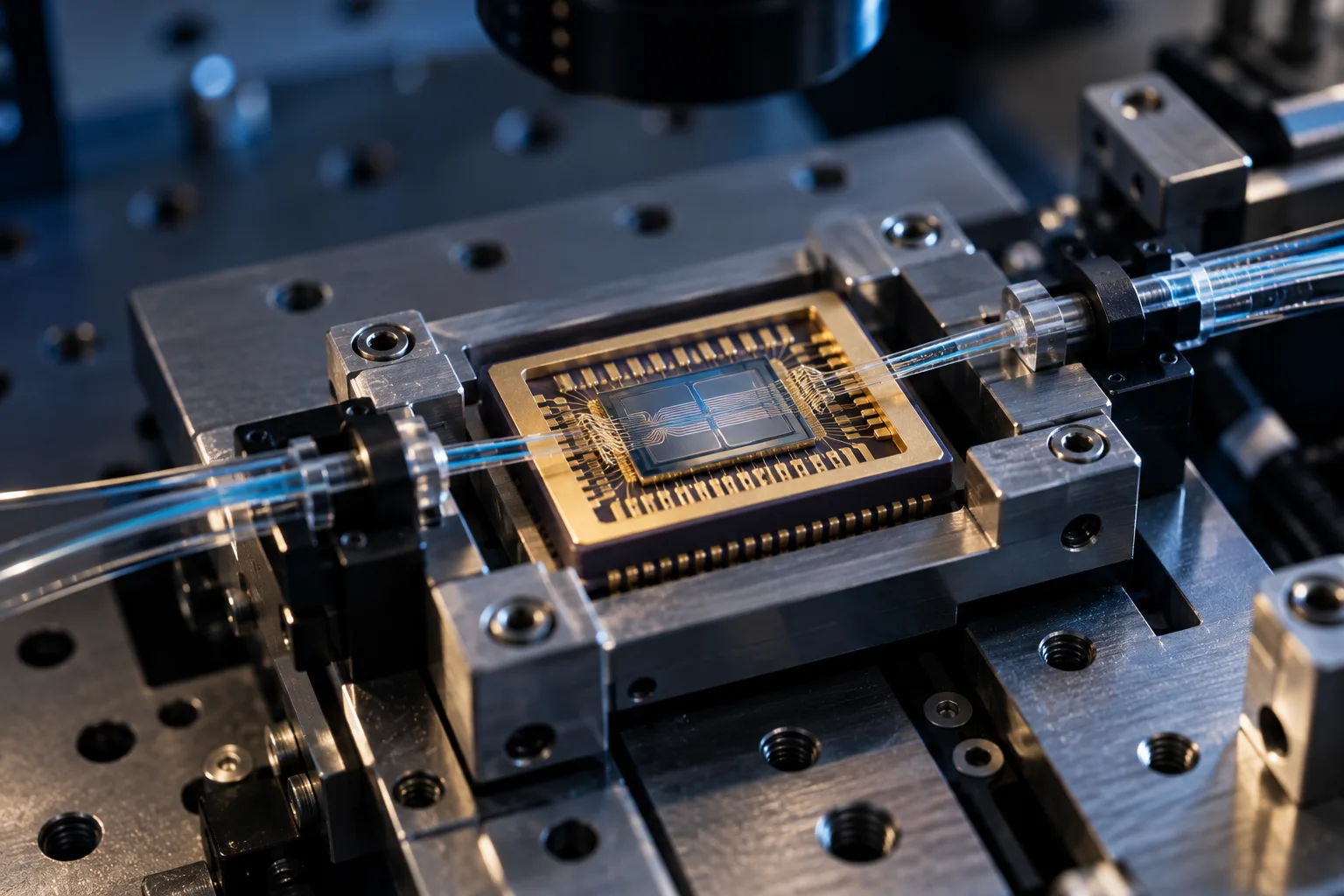
A neutral-atom quantum computer holds single atoms, usually rubidium or ytterbium, in place using very tightly focused laser beams called optical tweezers. Each atom's internal energy states can store one quantum bit, or qubit. Because the tweezers can be moved, the atoms can be rearranged into different patterns, and atoms can be made to interact with their neighbours by briefly exciting them with lasers.
The appeal is scale and flexibility. Experiments now hold thousands of atoms at once, and a 2025 Harvard-affiliated experiment reported running a 3,000-atom array for more than two hours by continuously reloading atoms that were lost. The hard part is error. Quantum states are fragile, so a useful machine will need many physical atoms working together to protect each logical qubit. The papers below show progress on that problem, but they are research demonstrations on small or specially designed circuits, not finished computers.
Technical explanation
Most systems encode each qubit in a pair of long-lived hyperfine or nuclear-spin states, often in rubidium or ytterbium atoms. Two-qubit gates use Rydberg excitation: a laser lifts atoms into highly excited states that interact strongly with nearby atoms, which entangles them. Evered and colleagues (2023) reported two-qubit entangling gates with 99.5% fidelity, demonstrated on up to 60 atoms in parallel, and state that this fidelity surpasses the surface-code threshold for error correction. Ma and colleagues (2023) used the nuclear spin of a metastable ytterbium-171 state and reported single-qubit and two-qubit gate fidelities of 0.9990(1) and 0.980(1). Fast mid-circuit detection converts many leakage errors into erasures with known positions; the authors report that the induced error on qubits still in the computational space during detection is below 10^-5.
Logical qubits encode one qubit across several physical atoms. Bluvstein and colleagues (2023) describe a programmable processor operating with up to 280 physical qubits, with sampling circuits on up to 48 logical qubits. Scaling the surface-code distance from 3 to 7 improved a two-qubit logic gate. The abstract says the logical encoding substantially improved algorithmic performance with error detection, which is not the same as full error correction. A preprint by Reichardt and colleagues (2024), with Atom Computing and Microsoft authors, reported 24 logical qubits entangled in 48 atoms, with an average of 1.8 lost atoms caught and corrected in that setting, and a Bernstein-Vazirani run on up to 28 logical qubits encoded in 112 atoms. A Nature paper by Bluvstein and colleagues (2026; preprint arXiv:2506.20661) reports reconfigurable arrays of up to 448 atoms and a 2.14(13)x below-threshold suppression factor in a four-round characterisation circuit with repeated error correction.
Scale and operation are also changing. Chiu and colleagues (2025) report an array of over 3,000 atoms maintained for more than two hours, reloaded at 300,000 atoms per second, with over 30,000 qubits initialised per second. The abstract states that moving atoms into tweezers did not affect the coherence of qubits stored nearby.
What the evidence says
Each statement is typed by the strength of its evidence and linked to the source that supports it.
Demonstrated Shown in a published experiment, test or shipping product.
Evered and colleagues report two-qubit entangling gates with 99.5% fidelity, demonstrated on up to 60 neutral atoms in parallel.
Sources: [1] · Abstract (arXiv:2304.05420)Ma and colleagues report single-qubit and two-qubit gate fidelities of 0.9990(1) and 0.980(1) for a neutral-atom qubit using the nuclear spin of a metastable ytterbium-171 state.
Sources: [2] · Abstract (arXiv:2305.05493)Fast mid-circuit detection in the ytterbium-171 work converts leakage errors into erasures, and the induced error on qubits still in the computational space during detection is below 10^-5.
Sources: [2] · Abstract (arXiv:2305.05493)Bluvstein and colleagues report a programmable processor operating with up to 280 physical qubits, running sampling circuits on up to 48 logical qubits. The authors say the logical encoding substantially improved algorithmic performance with error detection.
Sources: [3] · Abstract (arXiv:2312.03982)Chiu and colleagues report an array of over 3,000 neutral atoms maintained for more than two hours, reloaded at 300,000 atoms per second, and state that moving atoms into tweezers did not affect the coherence of nearby stored qubits.
Sources: [6] · Abstract (arXiv:2506.20660) · medium confidenceBluvstein and colleagues report repeated error correction on reconfigurable arrays of up to 448 neutral atoms, with 2.14(13) times below-threshold error suppression in a four-round characterisation circuit.
Sources: [7] · Abstract (arXiv:2506.20661) · medium confidenceReported, unverified Stated by a company or team but not independently confirmed.
A preprint reports 24 logical qubits entangled in 48 neutral atoms, with an average of 1.8 lost atoms caught and corrected in that setting.
Sources: [4], [5] · Abstract (arXiv:2411.11822) · medium confidenceMicrosoft and Atom Computing report a 99.6% two-qubit gate fidelity on a commercial neutral-atom system.
Sources: [5] · Blog post, 19 November 2024 · low confidenceProposed A design or plan that has not yet been built or tested.
The authors of the 2023 parallel-gate paper state that the 99.5% gate fidelity surpasses the surface-code threshold for error correction.
Sources: [1] · Abstract (arXiv:2304.05420) · medium confidenceThe authors describe the 2026 Nature work as implementing the key elements of a universal architecture for fault-tolerant quantum computation.
Sources: [7] · Abstract (arXiv:2506.20661) · medium confidenceLimitations and open problems
- Headline gate fidelities come from single-gate or short benchmark circuits. They do not show that a full algorithm will run reliably at scale.
- The 99.5% (Evered and colleagues) and 98.0% (Ma and colleagues) two-qubit fidelities come from different platforms and benchmark methods, so they are not directly comparable.
- Most logical-qubit results so far use error detection, small codes or specially designed circuits. The 2023 Harvard-affiliated logical processor paper reports improved algorithmic performance with error detection, not full error correction.
- Atoms are lost during operation. The 3,000-atom run depended on continuous reloading, and the authors state that longer operation needs better optical stabilisation.
- Several headline numbers come from a preprint (Reichardt and colleagues, 2024) or a company announcement (Microsoft and Atom Computing, 2024). When checked, the preprint had no journal reference and the blog post cited no peer-reviewed source.
Possible future uses
Ideas, not predictions. None of these has been demonstrated.
- Fault-tolerant machines that simulate chemistry and materials beyond the reach of classical computers, if logical error rates fall far enough.
- Quantum simulators built from the same tweezer arrays to study magnetism and other many-body physics.
- Hybrid systems that reuse optical tweezer hardware for precision sensing and atomic clocks.
Timeline
- Oct 2023Ma and colleagues report ytterbium-171 nuclear-spin qubits with 0.980(1) two-qubit gate fidelity and mid-circuit erasure conversion in Nature. Sources: [2]
- Oct 2023Evered and colleagues report 99.5% two-qubit gate fidelity on up to 60 atoms in parallel in Nature. Sources: [1]
- Dec 2023Bluvstein and colleagues post a preprint describing a programmable logical-qubit processor on up to 280 physical qubits, with sampling circuits on up to 48 logical qubits. Sources: [3]
- 18 Nov 2024Preprint reports 24 entangled logical qubits in 48 atoms, and Bernstein-Vazirani on up to 28 logical qubits in 112 atoms; Microsoft and Atom Computing announce the work the day after. Sources: [4], [5]
- Jun 2025Chiu and colleagues post a preprint reporting a 3,000-atom array run for more than two hours; the paper is published in Nature (volume 646, 2025). Sources: [6]
- Jan 2026Bluvstein and colleagues report reconfigurable arrays of up to 448 neutral atoms and 2.14(13) times below-threshold error suppression in a repeated error-correction circuit, in Nature. Sources: [7]
Futures this could help bring about
Related breakthroughs
Glossary
- Optical tweezer
- A tightly focused laser beam that traps and holds a single atom in place.
- Rydberg state
- A highly excited atomic state in which an electron sits far from the nucleus, so the atom interacts strongly with nearby atoms.
- Logical qubit
- A qubit encoded across several physical qubits so that errors can be detected or corrected.
- Erasure conversion
- A method that turns some errors into errors whose location is known, which makes them easier to correct.
Sources
- peer reviewed paper
High-fidelity parallel entangling gates on a neutral-atom quantum computer
Simon J. Evered, Dolev Bluvstein, Marcin Kalinowski et al.. Nature, Oct 2023. DOI: 10.1038/s41586-023-06481-y. Accessed 21 Oct 2026. - peer reviewed paper
High-fidelity gates with mid-circuit erasure conversion in a metastable neutral atom qubit
Shuo Ma, Genyue Liu, Pai Peng et al.. Nature, Oct 2023. DOI: 10.1038/s41586-023-06438-1. Accessed 21 Oct 2026. - peer reviewed paper
Logical quantum processor based on reconfigurable atom arrays
Dolev Bluvstein, Simon J. Evered, Alexandra A. Geim et al.. Nature, Dec 2023. DOI: 10.1038/s41586-023-06927-3. Accessed 21 Oct 2026. - preprint
Fault-tolerant quantum computation with a neutral atom processor
Ben W. Reichardt, Adam Paetznick, David Aasen et al.. arXiv, 18 Nov 2024. DOI: 10.48550/arXiv.2411.11822. Accessed 21 Oct 2026. - company announcement
Microsoft and Atom Computing offer a commercial quantum machine with the largest number of entangled logical qubits on record
Microsoft Azure Quantum blog, 19 Nov 2024. Accessed 21 Oct 2026. - peer reviewed paper
Continuous operation of a coherent 3,000-qubit system
Neng-Chun Chiu, et al.. Nature, Jun 2025. DOI: 10.1038/s41586-025-09596-6. Accessed 21 Oct 2026. - peer reviewed paper
A fault-tolerant neutral-atom architecture for universal quantum computation
Dolev Bluvstein, Alexandra A. Geim, Sophie H. Li et al.. Nature, Jan 2026. DOI: 10.1038/s41586-025-09848-5. Accessed 21 Oct 2026.
Revision history
3 changes since this profile was created.
What it took to get here
The inventions this technology was built on, oldest foundations at the top. Lines show what each one required.
- 2023Neutral-atom quantum computersResearch and prototypesRequires: Quantum error correction. Being researched.